


TLR2 and TLR4 expression and inflammatory cytokines are altered in the airway epithelium of those with alcohol use disorders
Supporting Files

-
9 2015
-
File Language:
English
Details
-
Alternative Title:Alcohol Clin Exp Res
-
Personal Author:
-
Description:Background
The lung has a highly regulated system of innate immunity to protect itself from inhaled microbes and toxins. The first line of defense is mucociliary clearance, but if invaders overcome this, inflammatory pathways are activated. Toll-like receptors (TLRs) are expressed on the airway epithelium. Their signaling initiates the inflammatory cascade and leads to production of inflammatory cytokines such as IL-6 and IL-8. We hypothesized that airway epithelial insults, including heavy alcohol intake or smoking, would alter the expression of TLRs on the airway epithelium
Methods
Bronchoscopy with bronchoalveolar lavage and brushings of the airway epithelium was performed in otherwise healthy subjects who had normal chest radiographs and spirometry. A history of alcohol use disorders (AUDs) was ascertained using the Alcohol Use Disorders Identification Test (AUDIT), and a history of cigarette smoking was also obtained. Age, gender and nutritional status in all groups were similar. We used real-time PCR to quantitate TLR1-TLR9 and enzyme-linked immune assay (ELISA) to measure TNFα, IL-6 and IL-8.
Results
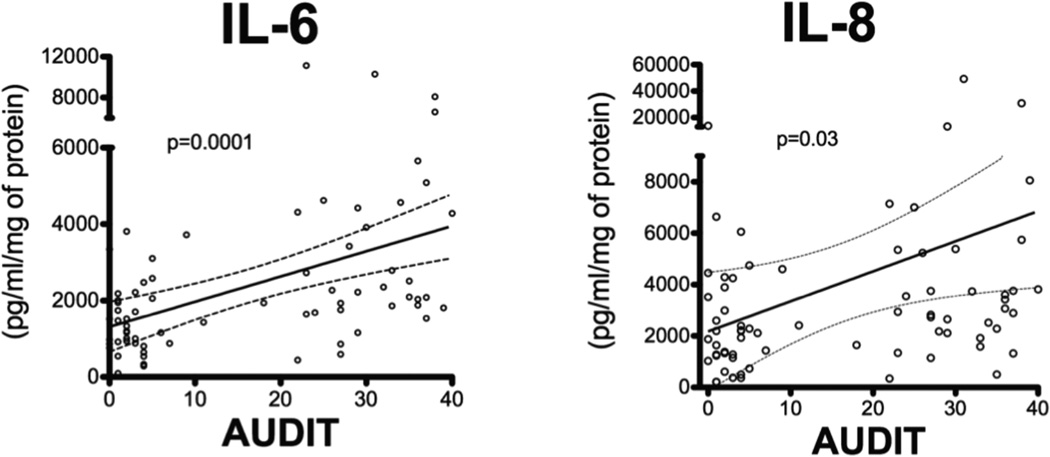
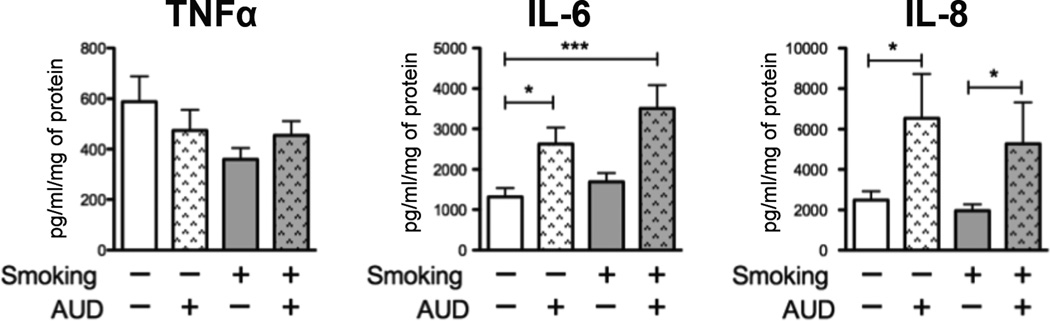
Airway brushings were obtained from 26 non-smoking/non-AUD subjects; 28 smoking/non-AUD subjects; 36 smoking/AUD subjects; and 17 non-smoking/AUD subjects. We found that TLR2 is upregulated in AUD subjects, compared to non-smoking/non-AUD subjects, and correlated with their AUDIT scores. We also measured a decrease in TLR4 expression in AUD subjects that correlated with AUDIT score. IL-6 and IL-8 were also increased in bronchial washings from AUD subjects.
Conclusions
We have previously demonstrated in normal human bronchial epithelial (NHBE) cells that in vitro alcohol exposure upregulates TLR2 though a NO/cGMP/PKG dependent pathway, resulting in upregulation of inflammatory cytokine production after gram-positive bacterial product stimulation. Our current translational study confirms that TLR2 is also upregulated in humans with AUDs.
-
Subjects:
-
Source:Alcohol Clin Exp Res. 39(9):1691-1697
-
Pubmed ID:26208141
-
Pubmed Central ID:PMC4843766
-
Document Type:
-
Funding:R01AA008769/AA/NIAAA NIH HHSUnited States/ ; R01 AA008769/AA/NIAAA NIH HHSUnited States/ ; K08AA019503/AA/NIAAA NIH HHSUnited States/ ; R24 AA019661/AA/NIAAA NIH HHSUnited States/ ; UL1 TR001082/TR/NCATS NIH HHSUnited States/ ; U54 OH010162/OH/NIOSH CDC HHSUnited States/ ; K08 AA019503/AA/NIAAA NIH HHSUnited States/ ; R24AA019661/AA/NIAAA NIH HHSUnited States/
-
Volume:39
-
Issue:9
-
Collection(s):
-
Main Document Checksum:urn:sha256:3842de90c9c700ca2ab617e7f85021d2fb0fef1ba6121090e6e7d42a5ebe3e2d
-
Download URL:
-
File Type:
 [PDF
- 1.49 MB
]
[PDF
- 1.49 MB
]
Supporting Files


File Language:
English
ON THIS PAGE





CDC STACKS serves as an archival repository of CDC-published products including
scientific findings,
journal articles, guidelines, recommendations, or other public health information authored or
co-authored by CDC or funded partners.
As a repository, CDC STACKS retains documents in their original published format to ensure public access to scientific information.
As a repository, CDC STACKS retains documents in their original published format to ensure public access to scientific information.
You May Also Like
COLLECTION
CDC Public Access