


Cost-effectiveness of seasonal inactivated influenza vaccination among pregnant women
Supporting Files

-
6 08 2016
-
File Language:
English
Details
-
Alternative Title:Vaccine
-
Personal Author:
-
Description:Objective:
To evaluate the cost-effectiveness of seasonal inactivated influenza vaccination among pregnant women using data from three recent influenza seasons in the United States.
Design, setting, and participants:
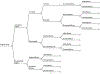
We developed a decision-analytic model following a cohort of 5.2 million pregnant women and their infants aged <6 months to evaluate the cost-effectiveness of vaccinating women against seasonal influenza during pregnancy from a societal perspective. The main outcome measures were quality-adjusted life-year (QALY) gained and cost-effectiveness ratios. Data sources included surveillance data, epidemiological studies, and published vaccine cost data. Sensitivity analyses were also performed. All costs and outcomes were discounted at 3% annually.
Main outcome measures:
Total costs (direct and indirect), effects (QALY gains, averted case numbers), and incremental cost-effectiveness of seasonal inactivated influenza vaccination among pregnant women (cost per QALY gained).
Results:
Using a recent benchmark of 52.2% vaccination coverage among pregnant women, we studied a hypothetical cohort of 2,753,015 vaccinated pregnant women. With an estimated vaccine effectiveness of 73% among pregnant women and 63% among infants <6 months, QALY gains for each season were 305 (2010–2011), 123 (2011–2012), and 610 (2012–2013). Compared with no vaccination, seasonal influenza vaccination during pregnancy was cost-saving when using data from the 2010–2011 and 2012–2013 influenza seasons. The cost-effectiveness ratio was greater than $100,000/QALY with the 2011–2012 influenza season data, when CDC reported a low attack rate compared to other recent seasons.
Conclusions:
Influenza vaccination for pregnant women can reduce morbidity from influenza in both pregnant women and their infants aged <6 months. Seasonal influenza vaccination during pregnancy is cost-saving during moderate to severe influenza seasons.
-
Subjects:
-
Source:Vaccine. 34(27):3149-3155
-
Pubmed ID:27161997
-
Pubmed Central ID:PMC8721743
-
Document Type:
-
Funding:
-
Volume:34
-
Issue:27
-
Collection(s):
-
Main Document Checksum:urn:sha256:388265271eeeaf4c034a13648f7da81e1a63236b17568d686db5737607ea2b0f
-
Download URL:
-
File Type:
 [PDF
- 394.36 KB
]
[PDF
- 394.36 KB
]
Supporting Files


File Language:
English
ON THIS PAGE



CDC STACKS serves as an archival repository of CDC-published products including
scientific findings,
journal articles, guidelines, recommendations, or other public health information authored or
co-authored by CDC or funded partners.
As a repository, CDC STACKS retains documents in their original published format to ensure public access to scientific information.
As a repository, CDC STACKS retains documents in their original published format to ensure public access to scientific information.
You May Also Like
COLLECTION
CDC Public Access