


Trends in human immunodeficiency virus diagnoses among men who have sex with men in North America, Western Europe, and Australia, 2000–2014
Supporting Files

-
12 2018
-
File Language:
English
Details
-
Alternative Title:Ann Epidemiol
-
Personal Author:Chapin-Bardales, Johanna ; Schmidt, Axel J. ; Guy, Rebecca J. ; Kaldor, John M. ; McGregor, Skye ; Sasse, André ; Archibald, Chris ; Rank, Claudia ; Barbará, Jordi Casabona ; Folch, Cinta ; Vives, Núria ; Cowan, Susan A. ; Cazein, Françoise ; Velter, Annie ; an der Heiden, Matthias ; Gunsenheimer-Bartmeyer, Barbara ; Marcus, Ulrich ; Op de Coul, Eline L.M. ; van Sighem, Ard ; Aldir, Isabel ; Cortes Martins, Helena ; Berglund, Torsten ; Velicko, Inga ; Gebhardt, Martin ; Delpech, Valerie ; Hughes, Gwenda ; Nardone, Anthony ; Irene Hall, H. ; Johnson, Anna S. ; Sullivan, Patrick S.
-
Description:Purpose:
The aim of the article was to investigate recent trends in human immunodeficiency virus (HIV) diagnosis rates among men who have sex with men (MSM) in high-income countries in North America, Western Europe, and Australia.
Methods:
Data on annual rates of HIV diagnoses among MSM aged 15 to 65 years from 2000 to 2014 were collected from 13 high-income countries. Joinpoint regression software was used to empirically determine country-specific trend periods. Trends in HIV diagnosis rates and in the proportion of diagnoses occurring in young MSM aged 15 to 24 years were analyzed using Poisson regression and log-binomial regression, respectively.
Results:
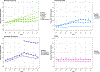
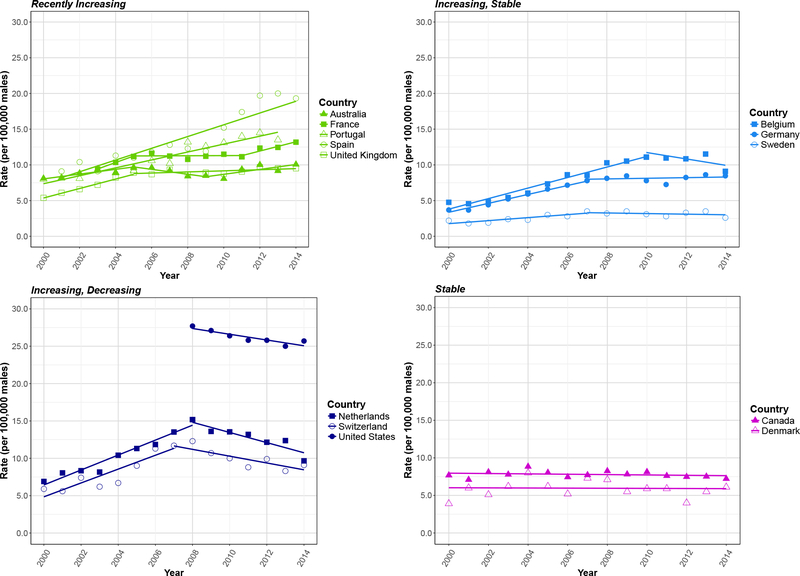
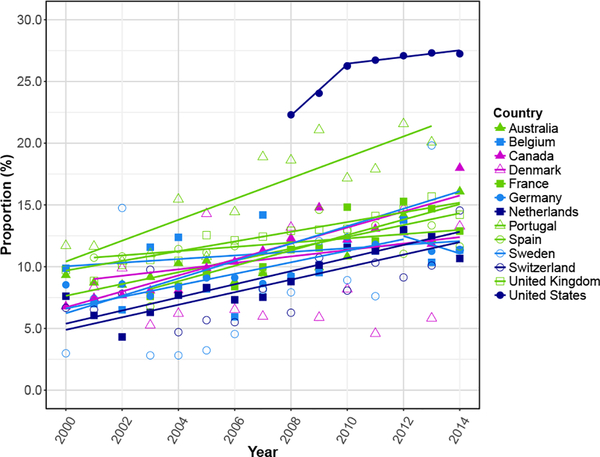
Six countries experienced an increasing trend from 2000 to 2007–08 followed by either a stable or declining trend through 2014. Five countries had recently increasing trends, and two countries had one stable trend from 2000 to 2014. All 13 countries experienced increases in the proportion of diagnoses occurring in young MSM.
Conclusions:
Since 2008, half of the 13 high-income countries examined experienced stable or decreasing trends. Still, some countries continue to experience increasing HIV trends, and young MSM are increasingly represented among new diagnoses. Efforts to support early sexual health promotion, reduce barriers to pre-exposure prophylaxis, and improve care engagement for young MSM are critical to addressing current HIV trends.
-
Subjects:
-
Source:Ann Epidemiol. 28(12):874-880
-
Pubmed ID:30389234
-
Pubmed Central ID:PMC8687130
-
Document Type:
-
Funding:
-
Place as Subject:
-
Volume:28
-
Issue:12
-
Collection(s):
-
Main Document Checksum:urn:sha256:151364ab0f8652f60b00e06c7e89dadac943c4d7e1dcf6ae2cf56679dc64ae94
-
Download URL:
-
File Type:
 [PDF
- 692.10 KB
]
[PDF
- 692.10 KB
]
Supporting Files


File Language:
English
ON THIS PAGE


CDC STACKS serves as an archival repository of CDC-published products including
scientific findings,
journal articles, guidelines, recommendations, or other public health information authored or
co-authored by CDC or funded partners.
As a repository, CDC STACKS retains documents in their original published format to ensure public access to scientific information.
As a repository, CDC STACKS retains documents in their original published format to ensure public access to scientific information.
You May Also Like
COLLECTION
CDC Public Access