


130. increase in Multidrug Resistance (2011–2018) and the Emergence of Extensive Drug Resistance (2020) in shigella Sonnei in the United States
Supporting Files
Public Domain

-
12 31 2020
-
Details
-
Alternative Title:Open Forum Infect Dis
-
Personal Author:Logan, Naeemah Z ; Karp, Beth E ; Tagg, Kaitlin A ; Burns-Lynch, Claire ; Chen, Jessica ; Garcia-Williams, Amanda ; Marsh, Zachary A ; O’Laughlin, Kevin ; Plumb, Ian D ; Schroeder, Morgan N ; Webb, Hattie E ; Zenas, Hannah ; Draper, Jenny ; Ginn, Andrew ; Martinez, Elena ; Partridge, Sally R ; Sim, Eby ; Sintchenko, Vitali ; Iredell, Jonathan ; Watkins, Louise Francois
-
Description:Background
Multidrug-resistant (MDR) Shigella sonnei infections are a serious public health threat, and outbreaks are common among men who have sex with men (MSM). In February 2020, Australia’s Department of Health notified CDC of extensively drug-resistant (XDR) S. sonnei in 2 Australian residents linked to a cruise that departed from Florida. We describe an international outbreak of XDR S. sonnei and report on trends in MDR among S. sonnei in the United States.
Methods
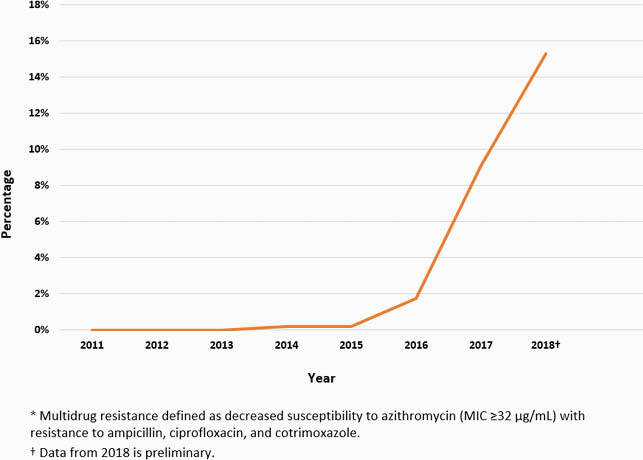
Health departments (HDs) submit every 20th Shigella isolate to CDC’s National Antimicrobial Resistance Monitoring System (NARMS) laboratory for susceptibility testing. We defined MDR as decreased susceptibility to azithromycin (MIC ≥32 µg/mL) with resistance to ampicillin, ciprofloxacin, and cotrimoxazole, and XDR as MDR with additional resistance to ceftriaxone. We used PulseNet, the national subtyping network for enteric disease surveillance, to identify US isolates related to the Australian XDR isolates by short-read whole genome sequencing. We screened these isolates for resistance determinants (ResFinder v3.0) and plasmid replicons (PlasmidFinder) and obtained patient histories from HDs. We used long-read sequencing to generate closed plasmid sequences for 2 XDR isolates.
Results
NARMS tested 2,781 S. sonnei surveillance isolates during 2011–2018; 80 (2.9%) were MDR, including 1 (0.04%) that was XDR. MDR isolates were from men (87%), women (9%), and children (4%). MDR increased from 0% in 2011 to 15.3% in 2018 (Figure). In 2020, we identified XDR isolates from 3 US residents on the same cruise as the Australians. The US residents were 41–42 year-old men; 2 with available information were MSM. The US and Australian isolates were highly related (0–1 alleles). Short-read sequence data from all 3 US isolates mapped to the blaCTX-M-27 harboring IncFII plasmids from the 2 Australian isolates with >99% nucleotide identity. blaCTX-M-27 genes confer ceftriaxone resistance.
Conclusion
MDR S. sonnei is increasing and is most often identified among men. XDR S. sonnei infections are emerging and are resistant to all recommended antibiotics, making them difficult to treat without IV antibiotics. This outbreak illustrates the alarming capacity for XDR S. sonnei to disseminate globally among at-risk populations, such as MSM.
Disclosures
All Authors: No reported disclosures
-
Subjects:
-
Source:Open Forum Infect Dis. 2020; 7(Suppl 1):S195
-
Pubmed Central ID:PMC7776455
-
Document Type:
-
Volume:7
-
Collection(s):
-
Main Document Checksum:urn:sha256:33e48d5ead756e299c346b1b067dce89b7fdf1585dad8ef4e92dbb14dbf7001f
-
Download URL:
-
File Type:
 [PDF
- 256.30 KB
]
[PDF
- 256.30 KB
]
Supporting Files


ON THIS PAGE

CDC STACKS serves as an archival repository of CDC-published products including
scientific findings,
journal articles, guidelines, recommendations, or other public health information authored or
co-authored by CDC or funded partners.
As a repository, CDC STACKS retains documents in their original published format to ensure public access to scientific information.
As a repository, CDC STACKS retains documents in their original published format to ensure public access to scientific information.
You May Also Like
COLLECTION
CDC Public Access