



918. Pilot Surveillance for Carbapenemase Gene-positive Organisms Among Hospitalized Solid Organ Transplant Recipients
Supporting Files
Public Domain

-
12 31 2020
-
Available in CDC Stacks on 2020-12-31T00:00:00Z
Details
-
Alternative Title:Open Forum Infect Dis
-
Personal Author:Chan, June L ; Nazarian, Elizabeth ; Musser, Kimberlee A ; Fung, Monica ; Doernberg, Sarah B ; Pouch, Stephanie M ; Pouch, Stephanie M ; Leekha, Surbhi ; Anesi, Judith A ; Kodiyanplakkal, Rosy Priya ; Turbett, Sarah ; Walters, Maroya Spalding ; Epstein, Lauren ; Epstein, Lauren
-
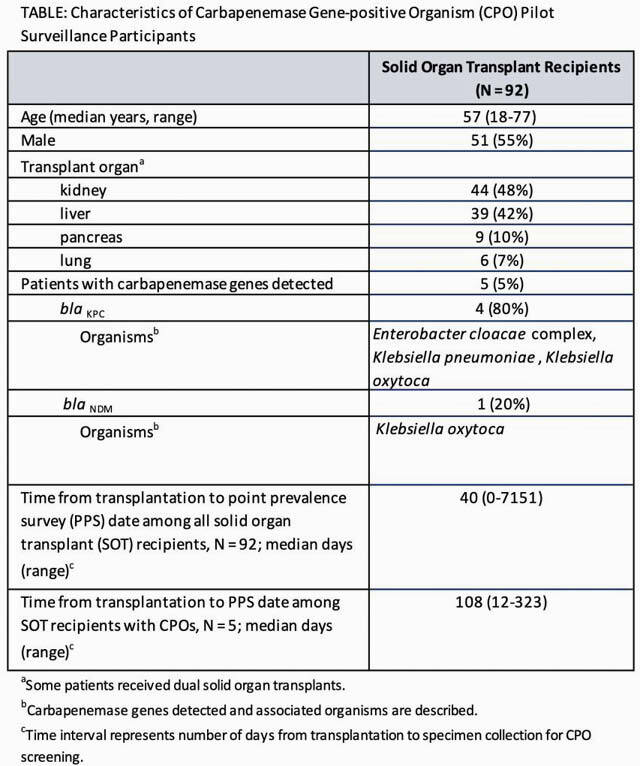
Description:Background ; Carbapenemase gene-positive organisms (CPOs) are associated with infections with high mortality rates and have the potential to facilitate epidemic spread of carbapenem resistance. Passive reporting to CDC identified CPOs among organ transplant recipients, potentially representing an emerging reservoir for spread. We aimed to determine the prevalence of CPOs in hospital units where solid organ transplant (SOT) recipients receive care in order to inform public health action to prevent transmission. ; Methods ; All healthcare facilities identified one medical unit where SOT recipients received inpatient care and conducted point prevalence surveys (PPS) of all consenting patients on 1-2 designated calendar days. We used the Cepheid Xpert® Carba-R assay to identify carbapenemase genes (blaKPC, blaNDM, blaVIM, blaIMP, blaOXA-48) from rectal swabs; carbapenemase-positive swabs were cultured for organisms. All laboratory testing was conducted at the Wadsworth Center, part of CDC’s Antibiotic Resistance Laboratory Network. ; Results ; Five participating hospitals performed nine PPS from September 2019 through June 2020. In total, 154 patients were screened and 92 (60%) were SOT recipients (Table). The most common transplanted organs were kidney (44, 48%) and liver (39, 42%). Carbapenemase genes were detected among 5 (5%) SOT recipients, all from a single healthcare facility; 4 (80%) were blaKPC and 1 (20%) was blaNDM. Of the positive specimens cultured, blaKPC was carried by Enterobacter cloacae complex (ECC), Klebsiella pneumoniae, and Klebsiella oxytoca and blaNDM was carried by K. oxytoca; blaKPC was carried by both ECC and K. pneumoniae in a single individual. For SOT patients with CPOs, the median interval from transplantation to swab collection was 108 days (range: 12 to 323). CPOs were only detected in 1 (2%) of 62 non-transplant patients. ; Conclusion ; Among participating facilities, most did not identify CPOs among patients admitted to transplant units. These findings represent a small number of patients and facilities; additional PPS in areas with varied CPO epidemiology are needed to understand whether SOT recipients should be routinely screened for CPOs. ; Disclosures ; All Authors: No reported disclosures
-
Subjects:
-
Source:Open Forum Infect Dis. 2020; 7(Suppl 1):S493-S494
-
Pubmed Central ID:PMC7776677
-
Document Type:
-
Volume:7
-
Download URL:
-
File Type:
 [PDF - 847.91 KB]
 -
Collection(s):
-
Main Document Checksum:urn:sha256:b5d5b5fc4c9519958878e57bde06257e2229989ca3a36b735b81ae880e85b2a9
Supporting Files


 Was this page helpful?
 Found an issue?

CDC STACKS serves as an archival repository of CDC-published products including
scientific findings, journal articles, guidelines, recommendations, or other public health information authored or
co-authored by CDC or funded partners.
As a repository, CDC STACKS retains documents in their original published format to ensure public access to scientific information.
As a repository, CDC STACKS retains documents in their original published format to ensure public access to scientific information.
You May Also Like
COLLECTION
CDC Public Access