



Antimicrobial Resistance in Typhoidal Salmonella: Surveillance for Enteric Fever in Asia Project, 2016–2019
Supporting Files
Public Domain

-
12 01 2020
-
Available in CDC Stacks on December 01, 2020, 12:00 AM
File Language:
English
Details
-
Alternative Title:Clin Infect Dis
-
Personal Author:Qamar, Farah N ; Yousafzai, Mohammad T ; Dehraj, Irum F ; Shakoor, Sadia ; Irfan, Seema ; Hotwani, Aneeta ; Hunzai, Muhammad J ; Thobani, Rozina S ; Rahman, Najeeb ; Mehmood, Junaid ; Hemlock, Caitlin ; Memon, Ashraf M ; Andrews, Jason R ; Luby, Stephen P ; Garrett, Denise O ; Longley, Ashley T ; Date, Kashmira ; Saha, Samir K
-
Description:Background
Clinicians have limited therapeutic options for enteric as a result of increasing antimicrobial resistance, and therefore typhoid vaccination is recommended as a preventive measure. As a part of the Surveillance for Enteric Fever in Asia Project (SEAP), we investigated the extent measured the burden of antimicrobial resistance (AMR) among confirmed enteric fever cases in Bangladesh, Nepal, and Pakistan.
Methods
From September 2016–September 2019, SEAP recruited study participants of all age groups from its outpatient, inpatient, hospital laboratory, laboratory network, and surgical sites who had a diagnosis of febrile illness that was either suspected or blood culture confirmed for enteric fever. Antimicrobial resistance of isolates was determined by disc diffusion using Clinical and Laboratory Standard Institute cut-off points. We reported the frequency of multidrug resistance (MDR)(resistance to ampicillin, cotrimoxazole, and chloramphenicol), extensive drug resistance (XDR) (MDR plus non-susceptible to fluoroquinolone and any 3rd generation cephalosporins), and fluoroquinolone (FQ) and azithromycin non-susceptibility.
Results
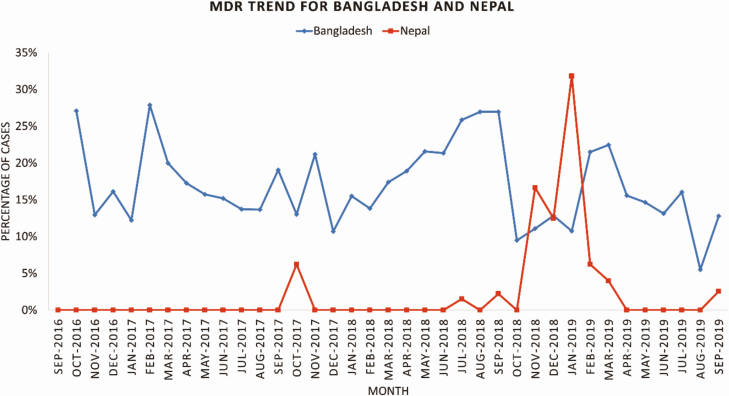
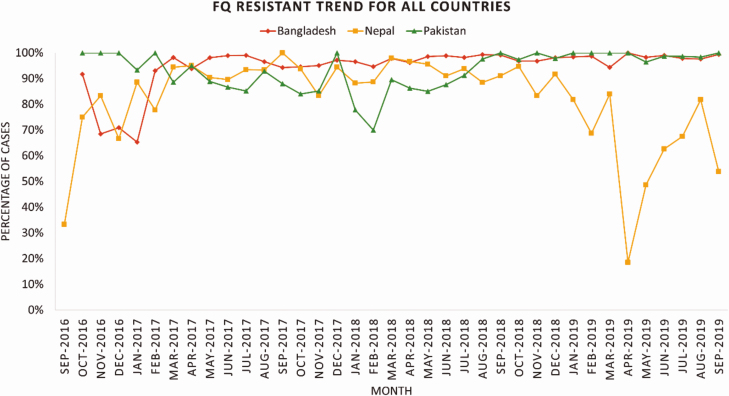
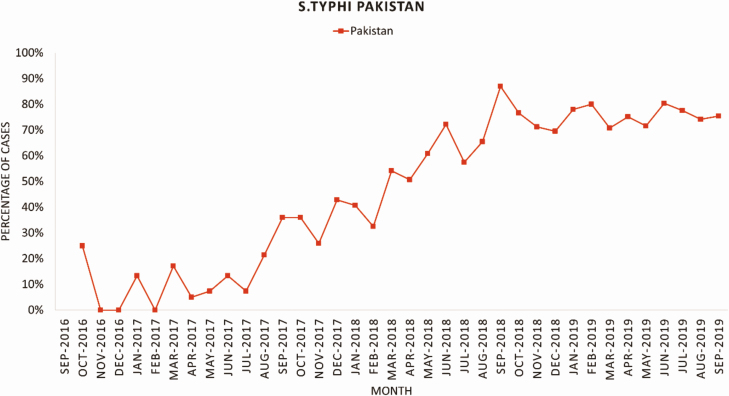
We enrolled 8,705 blood culture confirmed enteric fever cases: 4,873 (56%) from Bangladesh, 1,602 (18%) from Nepal and 2,230 (26%) from Pakistan. Of these, 7,591 (87%) were Salmonella Typhi and 1114 (13%) were S. Paratyphi. MDR S. Typhi was identified in 17% (701/4065) of isolates in Bangladesh, and 1% (19/1342) in Nepal. In Pakistan, 16 % (331/2084) of S. Typhi isolates were MDR, and 64% (1319/2074) were XDR. FQ nonsusceptibility among S. Typhi isolates was 98% in Bangladesh, 87% in Nepal, and 95% in Pakistan. Azithromycin non-susceptibility was detected in 77 (2%) in Bangladesh, 9 (.67%) in Nepal and 9 (.59%) isolates in Pakistan. In Pakistan, three (2%) S. Paratyphi isolates were MDR; no MDR S. Paratyphi was reported from Bangladesh or Nepal.
Conclusions
Although AMR against S. Paratyphi was low across the three countries, there was widespread drug resistance among S. Typhi, including FQ non-susceptibility and the emergence of XDR S. Typhi in Pakistan, limiting treatment options. As typhoid conjugate vaccine (TCV) is rolled out, surveillance should continue to monitor changes in AMR to inform policies and to monitor drug resistance in S. Paratyphi, for which there is no vaccine. -
Subjects:
- Supplement Articles
- AcademicSubjects/MED00290
- enteric fever
- antimicrobial resistance
- multidrug resistance
- extensive drug resistance
- Asia
- Anti-Bacterial Agents
- Bangladesh
- Drug Resistance, Bacterial
- Humans
- Microbial Sensitivity Tests
- Nepal
- Pakistan
- Salmonella paratyphi A
- Salmonella typhi
- Typhoid Fever
-
Source:Clin Infect Dis. 2020; 71(Suppl 3):S276-S284
-
Pubmed ID:33258934
-
Pubmed Central ID:PMC7705872
-
Document Type:
-
Volume:71
-
Download URL:
-
File Type:
 [PDF - 3.37 MB]
 -
Collection(s):
-
Main Document Checksum:urn:sha256:c26a2b365af5659b211cf3e0f4c2b37bad53e6c301c4abc084c5263556f14c63
Supporting Files


File Language:
English
 Was this page helpful?
 Found an issue?

CDC STACKS serves as an archival repository of CDC-published products including
scientific findings, journal articles, guidelines, recommendations, or other public health information authored or
co-authored by CDC or funded partners.
As a repository, CDC STACKS retains documents in their original published format to ensure public access to scientific information.
As a repository, CDC STACKS retains documents in their original published format to ensure public access to scientific information.
You May Also Like
COLLECTION
CDC Public Access