


Phylogenomic analysis reveals persistence of gonococcal strains with reduced-susceptibility to extended-spectrum cephalosporins and mosaic penA-34
Supporting Files
Public Domain

-
6 21 2021
-
File Language:
English
Details
-
Alternative Title:Nat Commun
-
Personal Author:
-
Corporate Authors:
-
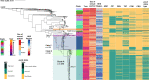
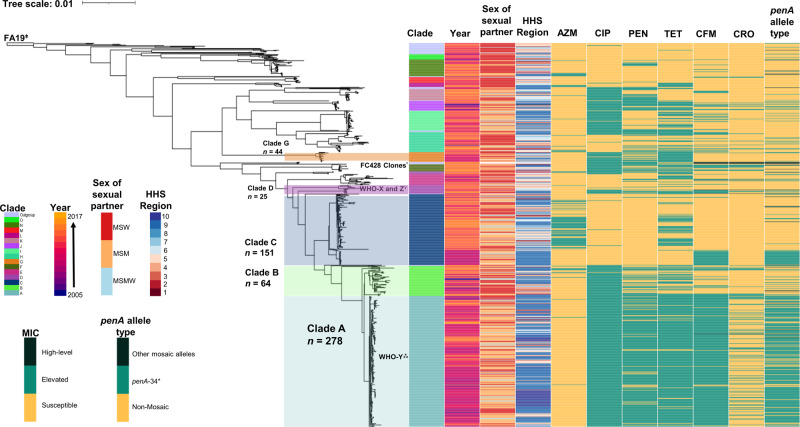
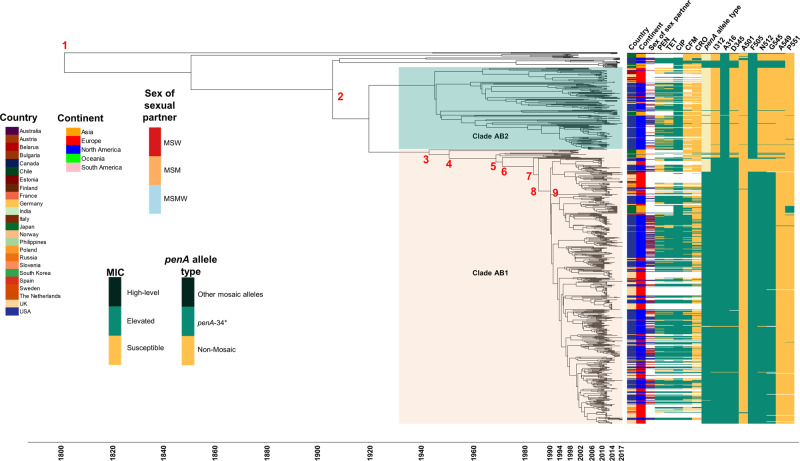
Description:The recent emergence of strains of Neisseria gonorrhoeae associated with treatment failures to ceftriaxone, the foundation of current treatment options, has raised concerns over a future of untreatable gonorrhea. Current global data on gonococcal strains suggest that several lineages, predominately characterized by mosaic penA alleles, are associated with elevated minimum inhibitory concentrations (MICs) to extended spectrum cephalosporins (ESCs). Here we report on whole genome sequences of 813 N. gonorrhoeae isolates collected through the Gonococcal Isolate Surveillance Project in the United States. Phylogenomic analysis revealed that one persisting lineage (Clade A, multi-locus sequence type [MLST] ST1901) with mosaic penA-34 alleles, contained the majority of isolates with elevated MICs to ESCs. We provide evidence that an ancestor to the globally circulating MLST ST1901 clones potentially emerged around the early to mid-20th century (1944, credibility intervals [CI]: 1935-1953), predating the introduction of cephalosporins, but coinciding with the use of penicillin. Such results indicate that drugs with novel mechanisms of action are needed as these strains continue to persist and disseminate globally.
-
Subjects:
-
Source:Nat Commun. 12
-
Pubmed ID:34155204
-
Pubmed Central ID:PMC8217231
-
Document Type:
-
Place as Subject:
-
Volume:12
-
Collection(s):
-
Main Document Checksum:urn:sha256:e473a7e4d58f8d9a252309fb1230ac18676c22f7071c1202455b2afdee6ba08f
-
Download URL:
-
File Type:
 [PDF
- 1.22 MB
]
[PDF
- 1.22 MB
]
Supporting Files


File Language:
English
ON THIS PAGE

CDC STACKS serves as an archival repository of CDC-published products including
scientific findings,
journal articles, guidelines, recommendations, or other public health information authored or
co-authored by CDC or funded partners.
As a repository, CDC STACKS retains documents in their original published format to ensure public access to scientific information.
As a repository, CDC STACKS retains documents in their original published format to ensure public access to scientific information.
You May Also Like
COLLECTION
CDC Public Access