


THE IMPACT OF NON-FATAL WORKPLACE INJURIES AND ILLNESSES ON MORTALITY
Supporting Files

-
12 2016
-
File Language:
English
Details
-
Alternative Title:Am J Ind Med
-
Personal Author:
-
Description:Background
Little research has examined the relationship between non-fatal workplace injuries and illnesses and long-term mortality.
Methods
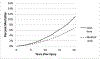
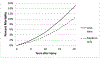
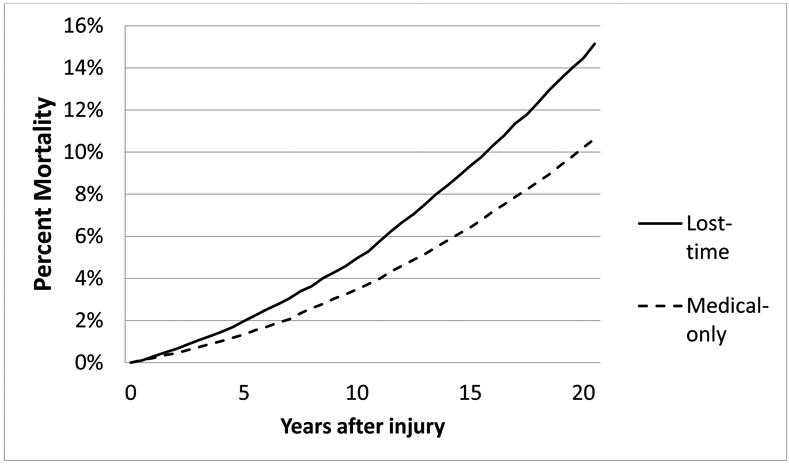
We linked non-fatal injury cases reported to the New Mexico workers’ compensation system 1994-2000 with Social Security Administration data on individual earnings and mortality through 2014. We then derived sex-specific Kaplan-Meier curves to show time to death for workers with lost-time injuries (n=36,377) and comparison workers (n=70,951). We fit multivariable Cox survival models to estimate the hazard ratio separately for male and female workers with lost-time injuries.
Results
The estimated hazard ratio for lost-time injuries is 1.24 for women and 1.21 for men. 95 percent confidence intervals were (1.15, 1.35) and (1.15, 1.27) respectively.
Conclusion
Lost-time occupational injuries are associated with a substantially elevated mortality hazard. This implies an important formerly unmeasured cost of these injuries and a further reason to focus on preventing them.
-
Subjects:
-
Source:Am J Ind Med. 59(12):1061-1069 ; Am J Ind Med. 59(12):1061-1069
-
Pubmed ID:27427538
-
Pubmed Central ID:PMC8576832
-
Document Type:
-
Funding:
-
Volume:59
-
Issue:12
-
Collection(s):
-
Main Document Checksum:urn:sha256:0a4eb8bff0a62d2b6a3f9f96c56857384007fb1970d072bd393ca44f28a246de
-
Download URL:
-
File Type:
 [PDF
- 125.12 KB
]
[PDF
- 125.12 KB
]
Supporting Files


File Language:
English
ON THIS PAGE


CDC STACKS serves as an archival repository of CDC-published products including
scientific findings,
journal articles, guidelines, recommendations, or other public health information authored or
co-authored by CDC or funded partners.
As a repository, CDC STACKS retains documents in their original published format to ensure public access to scientific information.
As a repository, CDC STACKS retains documents in their original published format to ensure public access to scientific information.
You May Also Like
COLLECTION
CDC Public Access