



Internet-Based Health Care Communication Among Cancer Survivors, 2011–2018 National Health Interview Survey
Supporting Files

-
9 09 2021
File Language:
English
Details
-
Journal Article:Preventing Chronic Disease (PCD)
-
Personal Author:
-
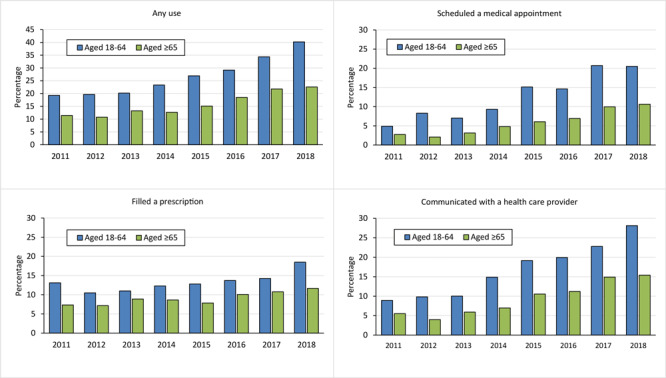
Description:Introduction ; Understanding trends and associated factors in internet-based health care communication (IBHC) among cancer survivors is important for meeting patient needs because their reliance on telehealth is growing. We aimed to examine IBHC use among cancer survivors in the US. ; Methods ; We identified adult cancer survivors aged 18 to 64 (n = 8,029) and 65 or older (n = 11,087) from the National Health Interview Survey in 2011–2018. We calculated temporal trends of self-reported IBHC in the previous year (filled a prescription, scheduled a medical appointment, or communicated with a health care provider) and used multivariable logistic models to identify associated factors. ; Results ; Approximately 84% of survivors had been diagnosed 2 years or more before the survey. IBHC prevalence increased among cancer survivors aged 18 to 64, from 19.3% to 40.2%, and among those aged 65 or older, from 11.4% to 22.6%, from 2011 to 2018 (P for trend <.001). Among both age groups, lower educational attainment, lack of usual source of care, and current smoking were associated with less IBHC, whereas residing in the South or West, having 1 or more chronic conditions, and drinking any alcohol were associated with higher IBHC (all P < .05). Factors associated with less IBHC also included being non-Hispanic Black or Hispanic, lacking private insurance, and being 11 or more years postdiagnosis among survivors aged 18 to 64; among survivors aged 65 or older, factors were being an older age, not married, and non-US born (all P < .05). ; Conclusion ; IBHC among cancer survivors is common and increasing, with differences across sociodemographic and behavioral characteristics. As health care delivery continues adopting IBHC and other advanced telehealth techniques, disparities need to be addressed to ensure equitable access to care for all cancer survivors.
-
Subjects:
-
Source:Prev Chronic Dis. 2021; 18
-
DOI:
-
ISSN:1545-1151
-
Pubmed ID:34499600
-
Pubmed Central ID:PMC8462291
-
Document Type:
-
Funding:
-
Place as Subject:
-
Location:
-
Volume:18
-
Download URL:
-
File Type:
 [PDF - 531.69 KB]
 -
Collection(s):
-
Main Document Checksum:urn:sha-512:225ecd97695a33d36ed38cff740cdc2849827cd0a59e254016756246eabfbd8dd6cd00340cfdce6c5499d36e262f57476cda6606eebc8a837acff20905161ab6
Supporting Files


File Language:
English
 Was this page helpful?
 Found an issue?

CDC STACKS serves as an archival repository of CDC-published products including
scientific findings, journal articles, guidelines, recommendations, or other public health information authored or
co-authored by CDC or funded partners.
As a repository, CDC STACKS retains documents in their original published format to ensure public access to scientific information.
As a repository, CDC STACKS retains documents in their original published format to ensure public access to scientific information.
You May Also Like
COLLECTION
Preventing Chronic Disease