


Disclosure of Sexual Behavior Is Significantly Associated With Receiving a Panel of Health Care Services Recommended for Men Who Have Sex With Men
Supporting Files

-
12 2018
-
File Language:
English
Details
-
Alternative Title:Sex Transm Dis
-
Personal Author:
-
Description:Background:
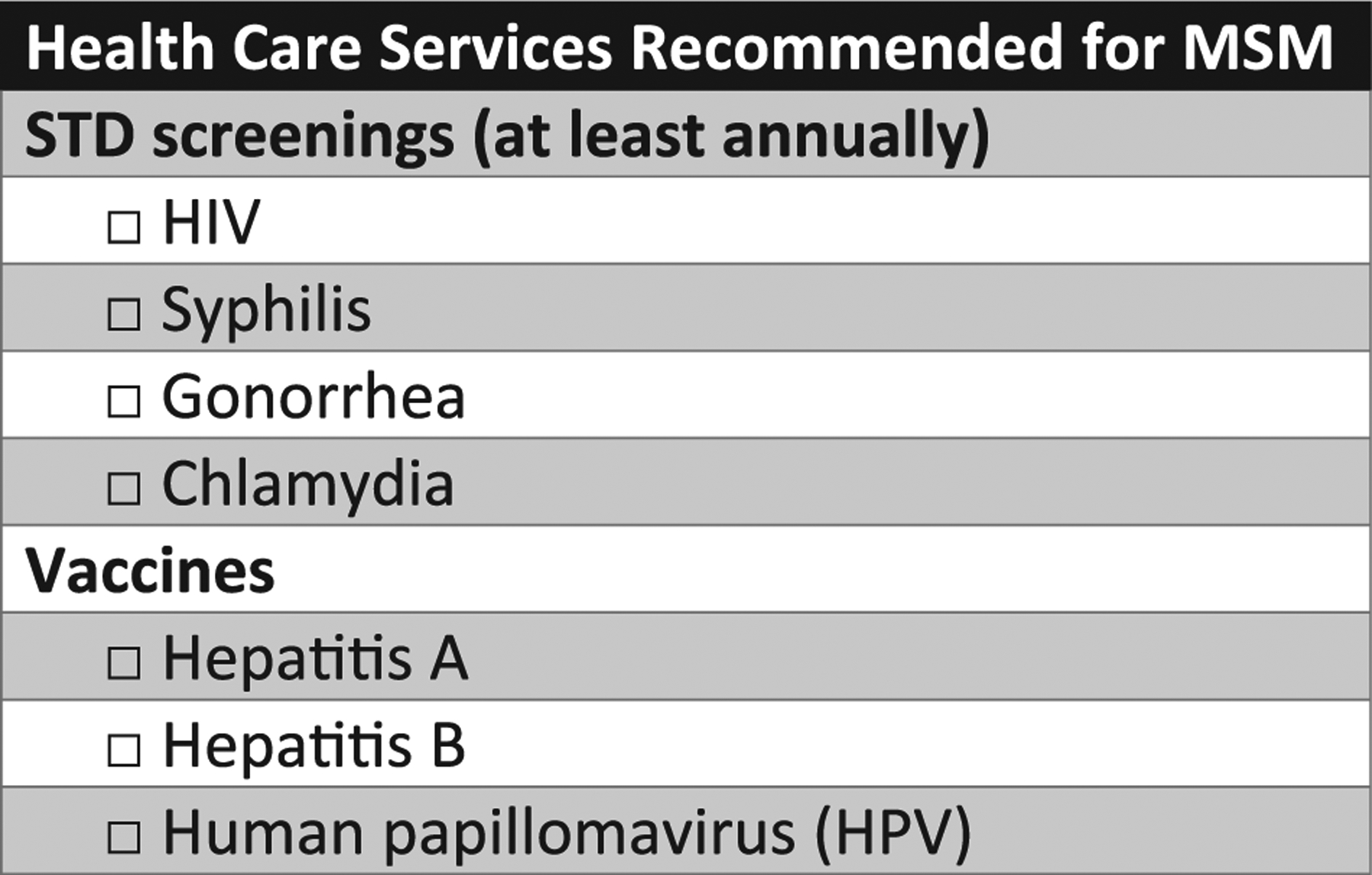
Men who have sex with men (MSM) are at high risk for sexually transmitted infections (STIs). National guidelines recommend that MSM receive HIV, syphilis, gonorrhea, and chlamydia screening at least annually, and hepatitis A and B and human papillomavirus vaccinations. We investigated associations between disclosure of male-male sexual orientation/behavior and receipt of this panel of services.
Methods:
Gay, bisexual, and other MSM aged 18 through 26 years were enrolled from health clinics serving lesbian, gay, bisexual, and transgender communities in Los Angeles and Chicago during 2012 to 2014. Participants completed a computer-assisted self-interview regarding health care services, disclosure of sexual orientation/behavior, and recent HIV test results. Proportions receiving recommended care, prevalence ratios (PRs), and 95% confidence intervals (CIs) were calculated using SAS 9.4.
Results:
Overall, 817 participants visited a provider within the past year. Of these, 525 (64.3%) had disclosed, and 749 (91.7%) felt they could disclose if important to health. In total, 548 (67.1%) received all STI screenings, and 74 (9.1%) received all vaccinations. Only 105 (12.9%) received any human papillomavirus vaccination. More disclosing participants received all recommended screenings (adjusted PR [aPR],1.4; 95% CI, 1.3–1.6) and all recommended care components (aPR, 2.2; 95% CI, 1.4–4.3) than nondisclosing participants.
Conclusions:
Despite national recommendations, receipt of a complete panel of STI care services was low among young MSM. Vaccine uptake was lower than STI screening. However, most participants visited a health care provider in the past year and most disclosed, suggesting opportunities to improve services. Providers might encourage disclosure by improving sexual history taking and education, which could increase opportunities for MSM to receive recommended care.
-
Subjects:
-
Source:Sex Transm Dis. 45(12):803-807
-
Pubmed ID:29944645
-
Pubmed Central ID:PMC8507165
-
Document Type:
-
Funding:
-
Volume:45
-
Issue:12
-
Collection(s):
-
Main Document Checksum:urn:sha256:f84bdfafd3aad4606f706c8b6534f0bdef999d48d82edbdbaaf4a923d8824453
-
Download URL:
-
File Type:
 [PDF
- 474.21 KB
]
[PDF
- 474.21 KB
]
Supporting Files


File Language:
English
ON THIS PAGE

CDC STACKS serves as an archival repository of CDC-published products including
scientific findings,
journal articles, guidelines, recommendations, or other public health information authored or
co-authored by CDC or funded partners.
As a repository, CDC STACKS retains documents in their original published format to ensure public access to scientific information.
As a repository, CDC STACKS retains documents in their original published format to ensure public access to scientific information.
You May Also Like
COLLECTION
CDC Public Access