


Effect of Survey Instrument on Participation in a Follow-Up Study: A Randomization Study of a Mailed Questionnaire Versus a Computer-Assisted Telephone Interview
Supporting Files

-
2012/07/31
-
File Language:
English
Details
-
Journal Article:BMC Public Health
-
Personal Author:
-
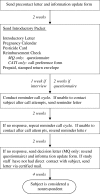
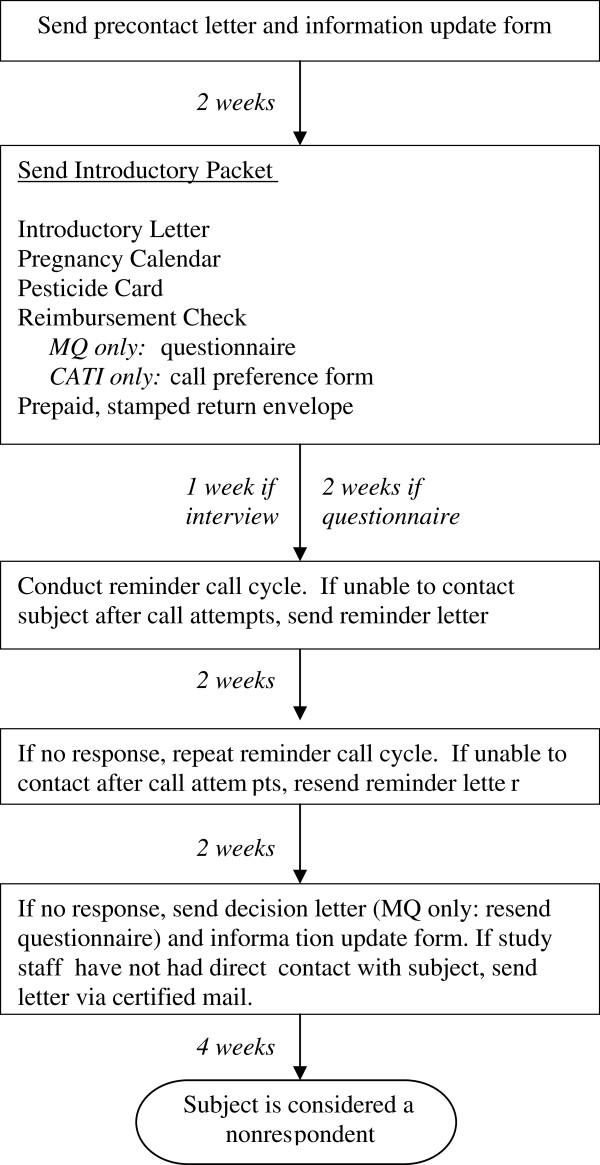
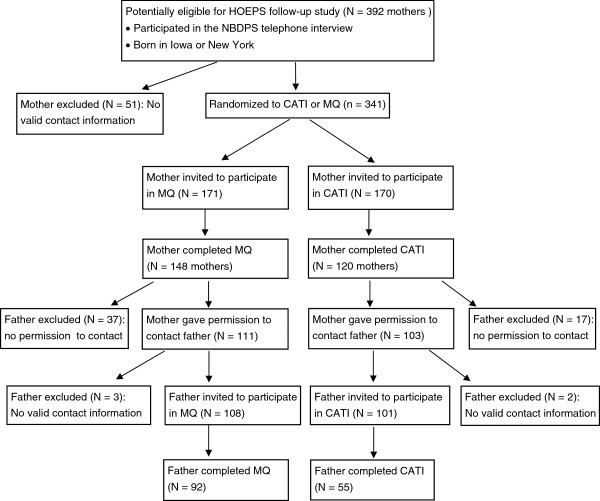
Description:Background: Many epidemiological and public health surveys report increasing difficulty obtaining high participation rates. We conducted a pilot follow-up study to determine whether a mailed or telephone survey would better facilitate data collection in a subset of respondents to an earlier telephone survey conducted as part of the National Birth Defects Prevention Study. Methods: We randomly assigned 392 eligible mothers to receive a self-administered, mailed questionnaire (MQ) or a computer-assisted telephone interview (CATI) using similar recruitment protocols. If mothers gave permission to contact the fathers, fathers were recruited to complete the same instrument (MQ or CATI) as mothers Results: Mothers contacted for the MQ, within all demographic strata examined, were more likely to participate than those contacted for the CATI (86.6% vs. 70.6%). The median response time for mothers completing the MQ was 17 days, compared to 29 days for mothers completing the CATI. Mothers completing the MQ also required fewer reminder calls or letters to finish participation versus those assigned to the CATI (median 3 versus 6), though they were less likely to give permission to contact the father (75.0% vs. 85.8%). Fathers contacted for the MQ, however, had higher participation compared to fathers contacted for the CATI (85.2% vs. 54.5%). Fathers recruited to the MQ also had a shorter response time (median 17 days) and required fewer reminder calls and letters (median 3 reminders) than those completing the CATI (medians 28 days and 6 reminders) Conclusions: We concluded that offering a MQ substantially improved participation rates and reduced recruitment effort compared to a CATI in this study. While a CATI has the advantage of being able to clarify answers to complex questions or eligibility requirements, our experience suggests that a MQ might be a good survey option for some studies. [Description provided by NIOSH]
-
Subjects:
-
Keywords:
-
Source:BMC Public Health 2012 Jul; 12:579
-
ISSN:1471-2458
-
Pubmed ID:22849754
-
Pubmed Central ID:PMC3506531
-
Document Type:
-
Funding:
-
Genre:
-
Place as Subject:
-
CIO:
-
Division:
-
Topic:
-
Location:
-
Pages in Document:10 pdf pages
-
Volume:12
-
NIOSHTIC Number:nn:20041814
-
Contact Point Address:Carissa M Rocheleau, Department of Epidemiology, College of Public Health, The University of Iowa, Iowa City, IA, 52242
-
Email:crocheleau@cdc.gov
-
Federal Fiscal Year:2012
-
NORA Priority Area:
-
Peer Reviewed:True
-
Collection(s):
-
Main Document Checksum:urn:sha-512:b662e62baf7a615fed821bd31ea6dca266042b795bf7f031e9b880486a627b663c1a2c17e371cb23627bce64136c01eeffae1ee1a37bd361d68a848b88b7a4e1
-
Download URL:
-
File Type:
 [PDF
- 272.29 KB
]
[PDF
- 272.29 KB
]
Supporting Files


File Language:
English
ON THIS PAGE

CDC STACKS serves as an archival repository of CDC-published products including
scientific findings,
journal articles, guidelines, recommendations, or other public health information authored or
co-authored by CDC or funded partners.
As a repository, CDC STACKS retains documents in their original published format to ensure public access to scientific information.
As a repository, CDC STACKS retains documents in their original published format to ensure public access to scientific information.
You May Also Like