


Temporal Association of Prostate Cancer Incidence with World Trade Center Rescue/Recovery Work
Supporting Files

-
10 2021
-
File Language:
English
Details
-
Alternative Title:Occup Environ Med
-
Personal Author:Goldfarb, David G. ; Zeig-Owens, Rachel ; Kristjansson, Dana ; Li, Jiehui ; Brackbill, Robert M. ; Farfel, Mark R. ; Cone, James E. ; Yung, Janette ; Kahn, Amy R. ; Qiao, Baozhen ; Schymura, Maria J. ; Webber, Mayris P. ; Dasaro, Christopher R. ; Shapiro, Moshe ; Lucchini, Roberto G. ; Todd, Andrew C. ; Prezant, David J. ; Boffetta, Paolo ; Hall, Charles B.
-
Description:Background:
The World Trade Center (WTC) attacks on 9/11/2001 created a hazardous environment with known and suspected carcinogens. Previous studies have identified an increased risk of prostate cancer in responder cohorts compared to the general male population.
Objectives:
To estimate the length of time to prostate cancer among WTC rescue/recovery workers by determining specific time periods during which the risk was significantly elevated.
Methods:
Person-time accruals began six months after enrollment into a WTC cohort and ended at death or 12/31/2015. Cancer data were obtained through linkages with 13 state cancer registries. New York State was the comparison population. We used Poisson regression to estimate hazard ratios and 95% confidence intervals; change points in rate ratios were estimated using profile likelihood.
Results:
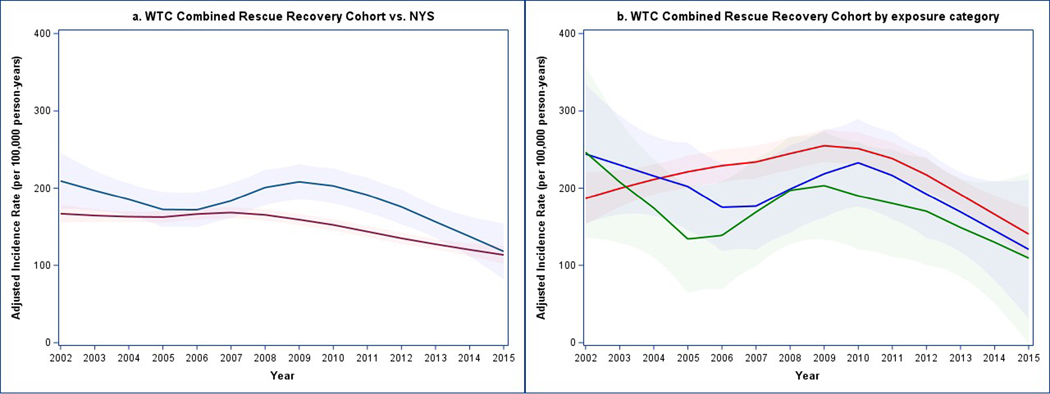
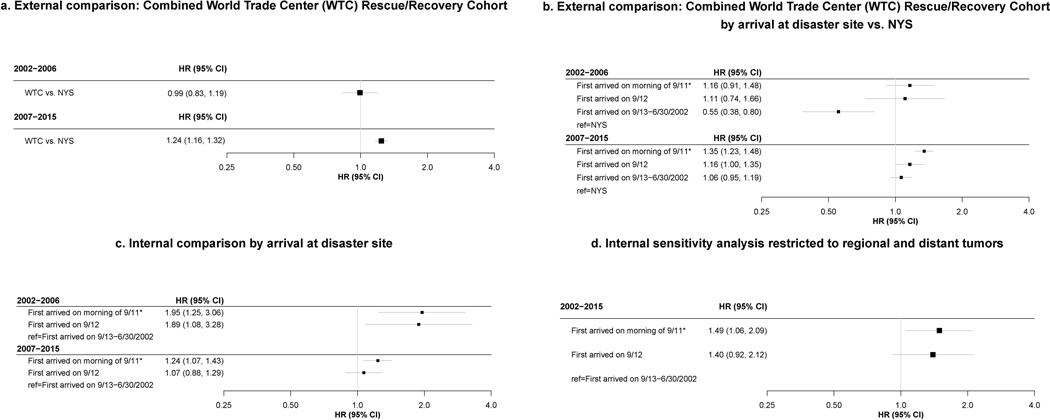
The analytic cohort included 54,394 male rescue/recovery workers. We observed 1,120 incident prostate cancer cases. During 2002–2006, no association with WTC exposure was detected. Beginning in 2007, a 24% increased risk (HR: 1.24, 95%CI: 1.16–1.32) was observed among WTC rescue/recovery workers when compared with New York State. Comparing those who arrived earliest at the disaster site on the morning of 9/11/2001 or any time on 9/12/2001 to those who first arrived later, we observed a positive, monotonic, dose-response association in the early (2002–2006) and late (2007–2015) periods.
Conclusions:
Risk of prostate cancer was significantly elevated beginning in 2007 in the WTC Combined Rescue/Recovery Cohort. While unique exposures at the disaster site might have contributed to the observed effect, screening practices including routine prostate specific antigen screening cannot be discounted.
-
Subjects:
-
Source:Occup Environ Med. 78(10):699-706
-
Pubmed ID:34507966
-
Pubmed Central ID:PMC8458078
-
Document Type:
-
Funding:HHSN261201800032C/CA/NCI NIH HHSUnited States/ ; HHSN261201800009C/CA/NCI NIH HHSUnited States/ ; U01 OH011931/OH/NIOSH CDC HHSUnited States/ ; HHSN261201800015I/CA/NCI NIH HHSUnited States/ ; U01 OH011932/OH/NIOSH CDC HHSUnited States/ ; U50 TS272750/TS/ATSDR CDC HHSUnited States/ ; HHSN261201800032I/CA/NCI NIH HHSUnited States/ ; U50 OH009739/OH/NIOSH CDC HHSUnited States/ ; HHSN261201800015C/CA/NCI NIH HHSUnited States/ ; P30 CA013330/CA/NCI NIH HHSUnited States/ ; U01 OH011681/OH/NIOSH CDC HHSUnited States/ ; NU58DP006344/DP/NCCDPHP CDC HHSUnited States/ ; U01 OH011480/OH/NIOSH CDC HHSUnited States/ ; HHSN261201800009I/CA/NCI NIH HHSUnited States/ ; U01 OH011315/OH/NIOSH CDC HHSUnited States/
-
Volume:78
-
Issue:10
-
Collection(s):
-
Main Document Checksum:urn:sha-512:500220b73dc538a33b083e332fc57d6589b04c17358e9d456cd2c6c137b6ff9eaa21fb55a5102427a883509243de65e0ca25350ac05de20d4f731d58f0ee6795
-
Download URL:
-
File Type:
 [PDF
- 735.35 KB
]
[PDF
- 735.35 KB
]
Supporting Files


File Language:
English
ON THIS PAGE



CDC STACKS serves as an archival repository of CDC-published products including
scientific findings,
journal articles, guidelines, recommendations, or other public health information authored or
co-authored by CDC or funded partners.
As a repository, CDC STACKS retains documents in their original published format to ensure public access to scientific information.
As a repository, CDC STACKS retains documents in their original published format to ensure public access to scientific information.
You May Also Like
COLLECTION
CDC Public Access