



Multiple Variants of SARS-CoV-2 in a University Outbreak After Spring Break — Chicago, Illinois, March–May 2021
Supporting Files
Public Domain

-
9 03 2021
File Language:
English
Details
-
Journal Article:Morbidity and Mortality Weekly Report (MMWR)
-
Personal Author:Doyle, Kate ; Teran, Richard A. ; Reefhuis, Jennita ; Kerins, Janna L. ; Qiu, Xueting ; Green, Stefan J. ; Choi, Hyeree ; Madni, Sabrina A. ; Kamal, Nazia ; Landon, Emily ; Albert, Reynald Christopher ; Pacilli, Massimo ; Furtado, Laura E. ; Hayden, Mary K. ; Kunstman, Kevin J. ; Bethel, Cindy ; Megger, Lauren ; Fricchione, Marielle J. ; Ghinai, Isaac
-
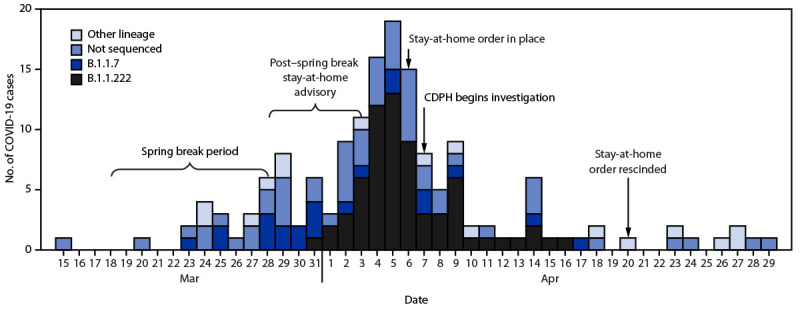
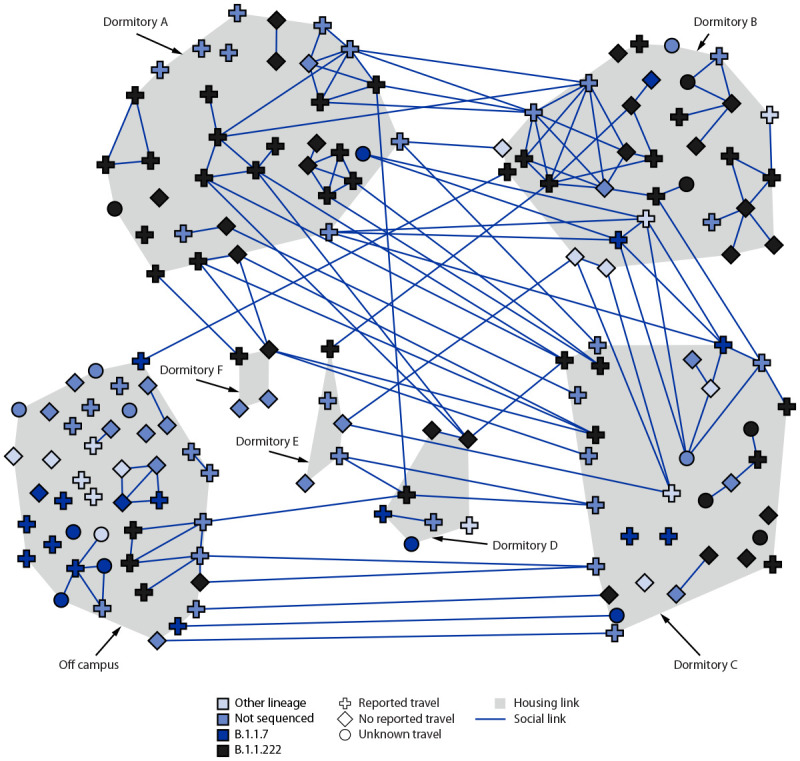
Description:To prevent Transmission of SARS-CoV-2, the Virus that causes COVID-19, colleges and universities have implemented multiple strategies including tTesting, isolation, quarantine, contact tracing, masking, and vaccination. In April 2021, the Chicago Department of Public Health (CDPH) was notified of a large cluster of students with COVID-19 at an urban university after spring break. A total of 158 cases of COVID-19 were diagnosed among undergraduate students during March 15-May 3, 2021; the majority (114; 72.2%) lived in on-campus dormitories. CDPH evaluated the role of travel and social connections, as well as the potential impact of SARS-CoV-2 Variantss, on Transmission. Among 140 infected students who were interviewed, 89 (63.6%) reported recent travel outside Chicago during spring break, and 57 (40.7%) reported indoor social exposures. At the time of the outbreak, undergraduate-aged persons were largely ineligible for vaccination in Chicago; only three of the students with COVID-19 (1.9%) were fully vaccinated. Whole genome sequencing (WGS) of 104 specimens revealed multiple distinct SARS-CoV-2 lineages, suggTesting several nearly simultaneous introductions. Most specimens (66; 63.5%) were B.1.1.222, a lineage not widely detected in Chicago before or after this outbreak. These results demonstrate the potential for COVID-19 outbreaks on university campuses after widespread student travel during breaks, at the beginning of new school terms, and when students participate in indoor social gatherings. To prevent SARS-CoV-2 Transmission, colleges and universities should encourage COVID-19 vaccination; discourage unvaccinated students from travel, including during university breaks; implement serial COVID-19 screening among unvaccinated persons after university breaks; encourage masking; and implement universal serial tTesting for students based on community Transmission levels.
-
Subjects:
-
Source:MMWR Morbidity Mortal Weekly Rep. 70(35):1195-1200
-
Series:
-
DOI:
-
ISSN:0149-2195 (print) ; 1545-861X (digital)
-
Pubmed ID:34473687
-
Pubmed Central ID:PMC8422867
-
Document Type:
-
Place as Subject:
-
Pages in Document:6 pdf pages
-
Volume:70
-
Issue:35
-
Download URL:
-
File Type:
 [PDF - 155.52 KB]
 -
Collection(s):
-
Main Document Checksum:urn:sha-512:55ba36ce3d19474aafc344f1bccfc54bf3b81702aa8be05af628d0181b7f8e2abe5ebbe0948f6456dfcf8d1d79b4b4e29379e84c9cc8b550701fe63c1ce08326
Supporting Files


File Language:
English
 Was this page helpful?
 Found an issue?


CDC STACKS serves as an archival repository of CDC-published products including
scientific findings, journal articles, guidelines, recommendations, or other public health information authored or
co-authored by CDC or funded partners.
As a repository, CDC STACKS retains documents in their original published format to ensure public access to scientific information.
As a repository, CDC STACKS retains documents in their original published format to ensure public access to scientific information.
You May Also Like
COLLECTION
Morbidity and Mortality Weekly Report (MMWR)