


Household Income and Cardiovascular Disease Risks in U.S. Children and Young Adults
Supporting Files
Public Domain

-
Sep 2011
-
Details
-
Alternative Title:Diabetes Care
-
Personal Author:
-
Description:OBJECTIVE
To assess the cardiovascular risk profile of youths across socioeconomic groups in the U.S.
RESEARCH DESIGN AND METHODS
Analysis of 1999–2008 National Health and Nutrition Examination Surveys (NHANES) including 16,085 nonpregnant 6- to 24-year-olds to estimate race/ethnicity-adjusted prevalence of obesity, central obesity, sedentary behaviors, tobacco exposure, elevated systolic blood pressure, glycated hemoglobin, non-HDL cholesterol (non–HDL-C), and high-sensitivity C-reactive protein according to age-group, sex, and poverty-income ratio (PIR) tertiles.
RESULTS
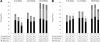
Among boys aged 6–11 years, 19.9% in the lowest PIR tertile were obese and 30.0% were centrally obese compared with 13.2 and 21.6%, respectively, in the highest-income tertile households (Pobesity < 0.05 and Pcentral obesity < 0.01). Boys aged 12–17 years in lowest-income households were more likely than their wealthiest family peers to be obese (20.6 vs. 15.6%, P < 0.05), sedentary (14.8 vs. 9.3%, P < 0.05), and exposed to tobacco (19.0 vs. 6.5%, P < 0.01). Compared with girls aged 12–17 years in highest-income households, lowest-income household girls had higher prevalence of obesity (17.9 vs. 13.1%, P < 0.05), central obesity (41.5 vs. 29.2%, P < 0.01), sedentary behaviors (20.4 vs. 9.4%, P < 0.01), and tobacco exposure (14.1 vs. 5.9%, P < 0.01). Apart from higher prevalence of elevated non–HDL-C among low-income women aged 18–24 years (23.4 vs. 15.8%, P < 0.05), no other cardiovascular disease risk factor prevalence differences were observed between lowest- and highest-income background young adults.
CONCLUSIONS
Independent of race/ethnicity, 6- to 17-year-olds from low-income families have higher prevalence of obesity, central obesity, sedentary behavior, and tobacco exposure. Multifaceted cardiovascular health promotion policies are needed to reduce health disparities between income groups.
-
Subjects:
-
Source:Diabetes Care. 2011; 34(9):1998-2004.
-
Document Type:
-
Volume:34
-
Issue:9
-
Collection(s):
-
Main Document Checksum:urn:sha256:627f1395c12aec0f87db2e7668b2b32abe0b01c5ebacceb80d57a6830a9411e6
-
Download URL:
-
File Type:
 [PDF
- 760.70 KB
]
[PDF
- 760.70 KB
]
Supporting Files


ON THIS PAGE


CDC STACKS serves as an archival repository of CDC-published products including
scientific findings,
journal articles, guidelines, recommendations, or other public health information authored or
co-authored by CDC or funded partners.
As a repository, CDC STACKS retains documents in their original published format to ensure public access to scientific information.
As a repository, CDC STACKS retains documents in their original published format to ensure public access to scientific information.
You May Also Like
COLLECTION
CDC Public Access