



QuickStats: Percentage of Children Aged 2-17 Years Who Wear Glasses Or Contact Lenses, by Sex and Age Group - National Health Interview Survey, United States, 2019
Supporting Files
Public Domain

-
2021/06/11
File Language:
English
Details
-
Alternative Title:Percentage of Children Aged 2-17 Years Who Wear Glasses or Contact Lenses, by Sex and Age Group - National Health Interview Survey, United States, 2019
-
Journal Article:Morbidity and Mortality Weekly Report (MMWR)
-
Personal Author:
-
Corporate Authors:
-
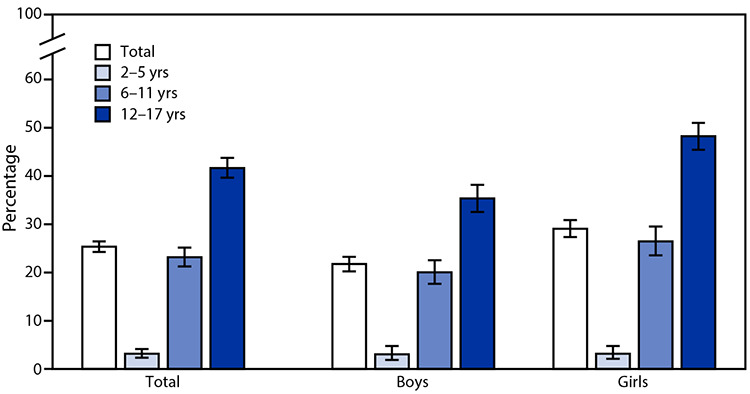
Description:In 2019, 25.3% of children aged 2-17 years wore glasses or contact lenses, and the percentage increased with age among both boys and girls. Among boys, 3.0% wore glasses among those aged 2-5 years, 20.0% among those aged 6-11 years, and 35.3% among those aged 12-17 years. Among girls, the corresponding percentages are 3.1, 26.4, and 48.2. The percentage was higher among girls than boys overall and among those aged 6-11 years and 12-17 years, but not in the youngest age group. ; Source: National Center for Health Statistics, National Health Interview Survey, 2019. https://www.cdc.gov/nchs/nhis.htm ; Reported by: Cynthia Reuben, MA; Nazik Elgaddal, MS.
-
Subjects:
-
Source:MMWR Morb Mortal Wkly Rep. 70(23):865
-
Series:
-
ISSN:0149-2195 (print) ; 1545-861X (digital)
-
Document Type:
-
Genre:
-
Place as Subject:
-
Pages in Document:1 pdf page
-
Volume:70
-
Issue:23
-
Download URL:
-
File Type:
 [PDF - 73.19 KB]
 -
Collection(s):
-
Main Document Checksum:urn:sha-512:784935bf260b7d4bd40fff730ef666f74e600a4003f10dbaaf4430bcaff8b8a94b804c6707cc8493d17a4cd1856c55007c6d1f1d462562914b40a7f2d6141467
Supporting Files


File Language:
English
 Was this page helpful?
 Found an issue?

CDC STACKS serves as an archival repository of CDC-published products including
scientific findings, journal articles, guidelines, recommendations, or other public health information authored or
co-authored by CDC or funded partners.
As a repository, CDC STACKS retains documents in their original published format to ensure public access to scientific information.
As a repository, CDC STACKS retains documents in their original published format to ensure public access to scientific information.
You May Also Like