



Effects of an “Active-Workstation” Cluster RCT on Daily Waking Physical Behaviors
Supporting Files

-
7 01 2021 ; 7-01-
-
Available in CDC Stacks on July 01, 2022, 12:00 AM
File Language:
English
Details
-
Alternative Title:Med Sci Sports Exerc
-
Personal Author:
-
Description:Purpose:
Evaluate the effects of sit-to-stand and treadmill desks on sedentary behavior during a 12-month, cluster-randomized multi-component intervention with an intent-to-treat design in overweight office workers.
Methods:
Sixty-six office workers were cluster-randomized into a: control (N=21; clusters=8), sit-to-stand desk (N=23; clusters=9) or treadmill desk (N=22; clusters=7) group. Participants wore an activPAL™ accelerometer for 7 days at baseline, month-3, month-6 and month-12 and received periodic feedback on their physical behaviors. The primary outcome was total daily sedentary time. Exploratory outcomes included total daily and workplace sedentary, standing and stepping time, and the number of total daily and workplace sedentary, standing and stepping bouts. Intervention effects were analyzed using random intercept mixed-linear-models accounting for repeated measures and clustering effects.
Results:
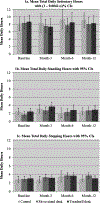
Total daily sedentary time did not significantly differ between- or within-groups after 12-months. Month-3 gains were observed in total daily and workplace standing time in both intervention groups (sit-to-stand desk: mean Δ±SD= 1.03±1.9 h/day and 1.10±1.87 h at work; treadmill desk: mean Δ±SD= 1.23±2.25 h/day and 1.44±2.54 h at work). At month-3 the treadmill desk users stepped more at the workplace than the control group (mean Δ±SD= 0.69±0.87 h). Month-6 gains in total daily stepping were observed within the sit-to-stand desk group (mean Δ±SD= 0.82±1.62 h/day) and month-3 gains in stepping at the workplace were observed for the treadmill desk group (mean Δ±SD= 0.77±0.83 h). These trends were sustained through month-12 in only the sit-to-stand desk group.
Conclusions:
Active-workstation interventions may cause short-term improvements in daily standing and stepping. Treadmill desk users engaged in fewer sedentary bouts but sit-to-stand desks resulted in more frequent transitions to upright physical behaviors. -
Subjects:
-
Keywords:
-
Source:Med Sci Sports Exerc. 53(7):1434-1445
-
Pubmed ID:33449603
-
Pubmed Central ID:PMC8205935
-
Document Type:
-
Funding:
-
Volume:53
-
Issue:7
-
Download URL:
-
File Type:
 [PDF - 530.42 KB]
 -
Collection(s):
-
Main Document Checksum:urn:sha256:b4ecd275b96e27762ba6ea525f5c8eade007f2c0e923d575dccdeefe592eb2b9
Supporting Files


File Language:
English
 Was this page helpful?
 Found an issue?



CDC STACKS serves as an archival repository of CDC-published products including
scientific findings, journal articles, guidelines, recommendations, or other public health information authored or
co-authored by CDC or funded partners.
As a repository, CDC STACKS retains documents in their original published format to ensure public access to scientific information.
As a repository, CDC STACKS retains documents in their original published format to ensure public access to scientific information.
You May Also Like
COLLECTION
CDC Public Access