


Symptoms and recovery among adult outpatients with and without COVID‐19 at 11 healthcare facilities—July 2020, United States
Supporting Files

-
May 2021
-
File Language:
English
Details
-
Alternative Title:Influenza Other Respir Viruses
-
Personal Author:Fisher, Kiva A. ; Olson, Samantha M. ; Tenforde, Mark W. ; Self, Wesley H. ; Wu, Michael ; Lindsell, Christopher J. ; Shapiro, Nathan I. ; Files, D. Clark ; Gibbs, Kevin W. ; Erickson, Heidi L. ; Prekker, Matthew E. ; Steingrub, Jay S. ; Exline, Matthew C. ; Henning, Daniel J. ; Wilson, Jennifer G. ; Brown, Samuel M. ; Peltan, Ithan D. ; Rice, Todd W. ; Hager, David N. ; Ginde, Adit A. ; Talbot, H. Keipp ; Casey, Jonathan D. ; Grijalva, Carlos G. ; Flannery, Brendan ; Patel, Manish M. ; Feldstein, Leora R. ; Hart, Kimberly W. ; McClellan, Robert ; Tan, Hsi‐nien ; Baughman, Adrienne ; Hennesy, Nora A. ; Grear, Brittany ; Mlynarczyk, Kristin ; Marzano, Luc ; Plata, Zuwena ; Caplan, Alexis ; Ogokeh, Constance E. ; Smith, Emily R. ; Kim, Sara S. ; Griggs, Eric P. ; Richards, Bridget ; Robinson, Sonya ; Kim, Kaylee ; Kassem, Ahmed M. ; Sciarratta, Courtney N. ; Marcet, Paula L.
-
Description:Background
Symptoms of mild COVID‐19 illness are non‐specific and may persist for prolonged periods. Effects on quality of life of persistent poor physical or mental health associated with COVID‐19 are not well understood.
Methods
Adults aged ≥18 years with laboratory‐confirmed COVID‐19 and matched control patients who tested negative for SARS‐CoV‐2 infection at outpatient facilities associated with 11 medical centers in the United States were interviewed to assess symptoms, illness duration, and health‐related quality of life. Duration of symptoms, health‐related quality of life measures, and days of poor physical health by symptoms experienced during illness were compared between case patients and controls using Wilcoxon rank‐sum tests. Symptoms associated with COVID‐19 case status were evaluated by multivariable logistic regression.
Results
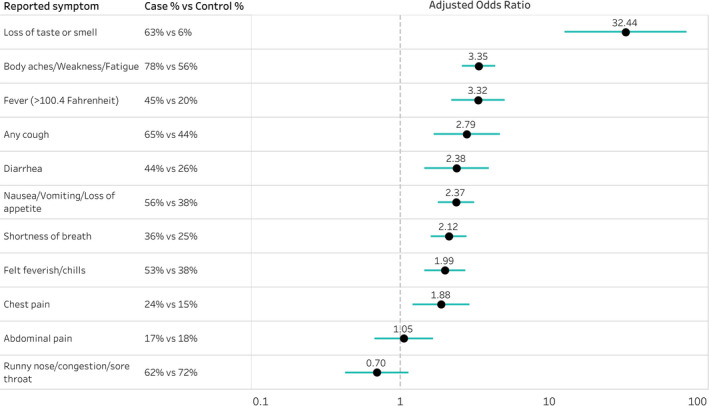
Among 320 participants included, 157 were COVID‐19 cases and 163 were SARS‐CoV‐2 negative controls. Loss of taste or smell was reported by 63% of cases and 6% of controls and was strongly associated with COVID‐19 in logistic regression models (adjusted odds ratio [aOR] = 32.4; 95% confidence interval [CI], 12.6‐83.1). COVID‐19 cases were more likely than controls to have experienced fever, body aches, weakness, or fatigue during illness, and to report ≥1 persistent symptom more than 14 days after symptom onset (50% vs 32%, P < .001). Cases reported significantly more days of poor physical health during the past 14 days than controls (P < .01).
Conclusions
Differentiating COVID‐19 from other acute illnesses will require widespread diagnostic testing, especially during influenza seasons. Persistent COVID‐19‐related symptoms may negatively affect quality of life, even among those initially presenting with mild illness.
-
Subjects:
-
Source:Influenza Other Respir Viruses. 15(3):345-351
-
Pubmed ID:33405338
-
Pubmed Central ID:PMC8051737
-
Document Type:
-
Funding:
-
Place as Subject:
-
Volume:15
-
Issue:3
-
Collection(s):
-
Main Document Checksum:urn:sha256:27f49fe35d649003b23e5861405cd5daa78a7ca6e0ce534a002b801a9965c823
-
Download URL:
-
File Type:
 [PDF
- 402.87 KB
]
[PDF
- 402.87 KB
]
Supporting Files


File Language:
English
ON THIS PAGE

CDC STACKS serves as an archival repository of CDC-published products including
scientific findings,
journal articles, guidelines, recommendations, or other public health information authored or
co-authored by CDC or funded partners.
As a repository, CDC STACKS retains documents in their original published format to ensure public access to scientific information.
As a repository, CDC STACKS retains documents in their original published format to ensure public access to scientific information.
You May Also Like
COLLECTION
CDC Public Access