


Polygenic prediction of PTSD trajectories in 9/11 responders
Supporting Files

-
10 23 2020
-
File Language:
English
Details
-
Alternative Title:Psychol Med
-
Personal Author:
-
Description:Background.
Genetics hold promise of predicting long-term post-traumatic stress disorder (PTSD) outcomes following trauma. The aim of the current study was to test whether six hypothesized polygenic risk scores (PRSs) developed to capture genetic vulnerability to psychiatric conditions prospectively predict PTSD onset, severity, and 18-year course after trauma exposure.
Methods.
Participants were 1490 responders to the World Trade Center (WTC) disaster (mean age at 9/11 = 38.81 years, S.D. = 8.20; 93.5% male; 23.8% lifetime WTC-related PTSD diagnosis). Prospective longitudinal data on WTC-related PTSD symptoms were obtained from electronic medical records and modelled as PTSD trajectories using growth mixture model analysis. Independent regression models tested whether six hypothesized psychiatric PRSs (PTSD-PRS, Re-experiencing-PRS, Generalized Anxiety-PRS, Schizophrenia-PRS, Depression-PRS, and Neuroticism-PRS) are predictive of WTC-PTSD outcomes: lifetime diagnoses, average symptom severity, and 18-year symptom trajectory. All analyses were adjusted for population stratification, 9/11 exposure severity, and multiple testing.
Results.
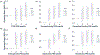
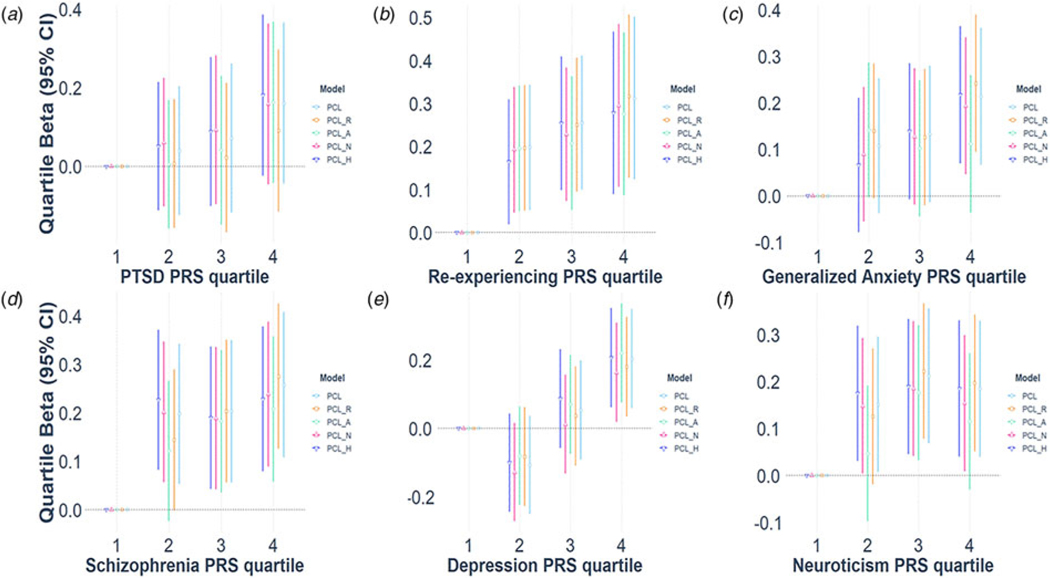
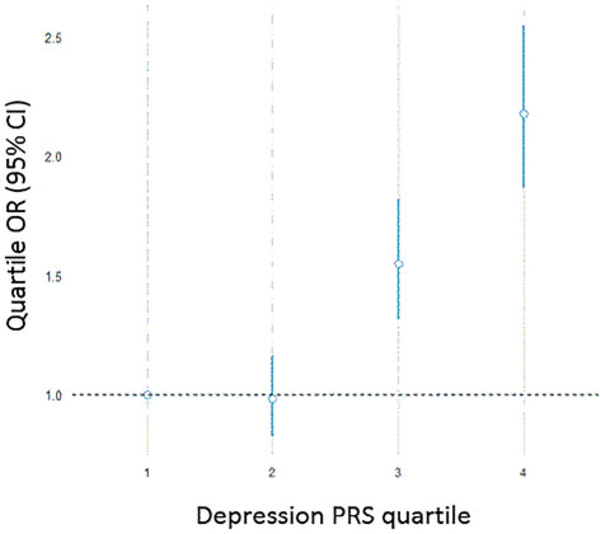
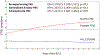
Depression-PRS predicted PTSD diagnostic status (OR 1.37, CI 1.17–1.61, adjusted p = 0.001). All PRSs, except PTSD-PRS, significantly predicted average PTSD symptoms (β = 0.06–0.10, adjusted p < 0.05). Re-experiencing-PRS, Generalized Anxiety-PRS and Schizophrenia-PRS predicted the high severity PTSD trajectory class (ORs 1.21–1.28, adjusted p < 0.05). Finally, PRSs prediction was independent of 9/11 exposure severity and jointly accounted for 3.7 times more variance in PTSD symptoms than the exposure severity.
Conclusions.
Psychiatric PRSs prospectively predicted WTC-related PTSD lifetime diagnosis, average symptom severity, and 18-year trajectory in responders to 9/11 disaster. Jointly, PRSs were more predictive of subsequent PTSD than the exposure severity. In the future, PRSs may help identify at-risk responders who might benefit from targeted prevention approaches.
-
Subjects:
-
Source:Psychol Med. :1-9
-
Pubmed ID:33092657
-
Pubmed Central ID:PMC8186149
-
Document Type:
-
Funding:U01 OH011864/OH/NIOSH CDC HHSUnited States/ ; U01 OH010718/OH/NIOSH CDC HHSUnited States/ ; UL1 TR002538/TR/NCATS NIH HHSUnited States/ ; K01 MH093731/MH/NIMH NIH HHSUnited States/ ; R01 MH123619/MH/NIMH NIH HHSUnited States/ ; K01 MH109765/MH/NIMH NIH HHSUnited States/ ; U01 OH010416/OH/NIOSH CDC HHSUnited States/
-
Collection(s):
-
Main Document Checksum:urn:sha256:70226432f5b88b13bbab81d2e250862eae9235e43ed47604d9287b7659fd4c8f
-
Download URL:
-
File Type:
 [PDF
- 833.64 KB
]
[PDF
- 833.64 KB
]
Supporting Files


File Language:
English
ON THIS PAGE



CDC STACKS serves as an archival repository of CDC-published products including
scientific findings,
journal articles, guidelines, recommendations, or other public health information authored or
co-authored by CDC or funded partners.
As a repository, CDC STACKS retains documents in their original published format to ensure public access to scientific information.
As a repository, CDC STACKS retains documents in their original published format to ensure public access to scientific information.
You May Also Like
COLLECTION
CDC Public Access