



Differences in rapid increases in county-level COVID-19 incidence by implementation of statewide closures and mask mandates — United States, June 1–September 30, 2020
Supporting Files
Public Domain

-
February 14 2021
-
Available in CDC Stacks on May 01, 2021, 12:00 AM
File Language:
English
Details
-
Alternative Title:Ann Epidemiol
-
Personal Author:Dasgupta, Sharoda ; Kassem, Ahmed M. ; Sunshine, Gregory ; Liu, Tiebin ; Rose, Charles ; Kang, Gloria J. ; Silver, Rachel ; Maddox, Brandy L. Peterson ; Watson, Christina ; Howard-Williams, Mara ; Gakh, Maxim ; McCord, Russell ; Weber, Regen ; Fletcher, Kelly ; Musial, Trieste ; Tynan, Michael A. ; Hulkower, Rachel ; Moreland, Amanda ; Pepin, Dawn ; Landsman, Lisa ; Brown, Amanda ; Gilchrist, Siobhan ; Clodfelter, Catherine ; Williams, Michael ; Cramer, Ryan ; Limeres, Alexa ; Popoola, Adebola ; Dugmeoglu, Sebnem ; Shelburne, Julia ; Jeong, Gi ; Rao, Carol Y.
-
Description:Background and Objective
Community mitigation strategies could help reduce COVID-19 incidence, but there are few studies that explore associations nationally and by urbanicity. In a national county-level analysis, we examined the probability of being identified as a county with rapidly increasing COVID-19 incidence (rapid riser identification) during the summer of 2020 by implementation of mitigation policies prior to the summer, overall and by urbanicity.
Methods
We analyzed county-level data on rapid riser identification during June 1–September 30, 2020 and statewide closures and statewide mask mandates starting March 19 (obtained from state government websites). Poisson regression models with robust standard error estimation were used to examine differences in the probability of rapid riser identification by implementation of mitigation policies (P-value< .05); associations were adjusted for county population size.
Results
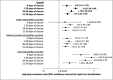
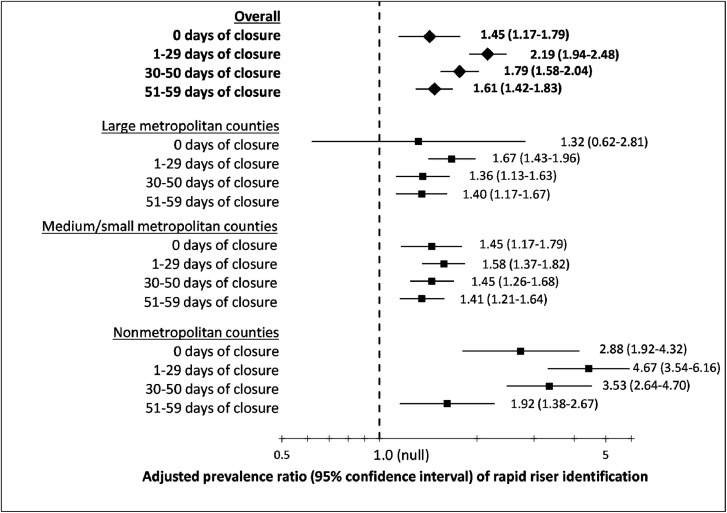
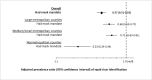
Counties in states that closed for 0–59 days were more likely to become a rapid riser county than those that closed for >59 days, particularly in nonmetropolitan areas. The probability of becoming a rapid riser county was 43% lower among counties that had statewide mask mandates at reopening (adjusted prevalence ratio = 0.57; 95% confidence intervals = 0.51–0.63); when stratified by urbanicity, associations were more pronounced in nonmetropolitan areas.
Conclusions
These results underscore the potential value of community mitigation strategies in limiting the COVID-19 spread, especially in nonmetropolitan areas. -
Subjects:
-
Source:Ann Epidemiol. 2021; 57:46-53
-
Pubmed ID:33596446
-
Pubmed Central ID:PMC7882220
-
Document Type:
-
Place as Subject:
-
Volume:57
-
Download URL:
-
File Type:
 [PDF - 1.07 MB]
 -
Collection(s):
-
Main Document Checksum:urn:sha256:ee4891fcff4d10fa2ba100eac9b6bdb4bc2f04509a01001c9f6e95f3db4ec5eb
Supporting Files


File Language:
English
 Was this page helpful?
 Found an issue?



CDC STACKS serves as an archival repository of CDC-published products including
scientific findings, journal articles, guidelines, recommendations, or other public health information authored or
co-authored by CDC or funded partners.
As a repository, CDC STACKS retains documents in their original published format to ensure public access to scientific information.
As a repository, CDC STACKS retains documents in their original published format to ensure public access to scientific information.
You May Also Like
COLLECTION
CDC Public Access