



Organic dust induced mitochondrial dysfunction could be targeted via cGAS-STING or cytoplasmic NOX-2 inhibition using microglial cells and brain slice culture models
Supporting Files

-
5 2021 ; 5-2021
-
Available in CDC Stacks on 2022-05-01T00:00:00Z
File Language:
English
Details
-
Alternative Title:Cell Tissue Res
-
Personal Author:
-
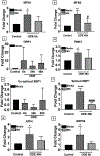
Description:Organic dust (OD) exposure in animal production industries poses serious respiratory and other health risks. OD consisting of microbial products and particulate matter and OD exposure-induced respiratory inflammation are under investigation. However, the effect of OD exposure on brain remains elusive. We show that OD exposure of microglial cells induces an inflammatory phenotype with the release of mitochondrial DNA (mt-DNA). Therefore, we tested a hypothesis that OD exposure-induced secreted mt-DNA signaling drives the inflammation. A mouse microglial cell line was treated with medium or organic dust extract (ODE, 1% v/v) along with either phosphate-buffered saline (PBS) or mitoapocynin (MA, 10 µmol). Microglia treated with control or anti-STING siRNA were exposed to medium or ODE. Mouse organotypic brain slice cultures (BSCs) were exposed to medium or ODE with or without MA. Various samples were processed to quantify mitochondrial reactive oxygen species (mt-ROS), mt-DNA, cytochrome c, TFAM, mitochondrial stress markers and mt-DNA-induced signaling via cGAS-STING and TLR9. Data were analyzed and a p value of ≤ 0.05 was considered significant. MA treatment decreased the ODE-induced mt-DNA release into the cytosol. ODE increased MFN1/2 and PINK1 but not DRP1 and MA treatment decreased the MFN2 expression. MA treatment decreased the ODE exposure-induced mt-DNA signaling via cGAS-STING and TLR9. Anti-STING siRNA decreased the ODE-induced increase in IRF3, IFN-β and IBA-1 expression. In BSCs, MA treatment decreased the ODE-induced TNF-α, IL-6 and MFN1. Therefore, OD exposure-induced mt-DNA signaling was curtailed through cytoplasmic NOX-2 inhibition or STING suppression to reduce brain microglial inflammatory response.
-
Subjects:
-
Keywords:
-
Source:Cell Tissue Res. 384(2):465-486
-
Pubmed ID:33687557
-
Pubmed Central ID:PMC8154696
-
Document Type:
-
Funding:
-
Volume:384
-
Issue:2
-
Download URL:
-
File Type:
 [PDF - 2.45 MB]
 -
Collection(s):
-
Main Document Checksum:urn:sha256:c405270c8f3572883d232faaa47894a459a9fc22f3f0edd35af1b69e96202730

Supporting Files


File Language:
English
 Was this page helpful?
 Found an issue?




CDC STACKS serves as an archival repository of CDC-published products including
scientific findings, journal articles, guidelines, recommendations, or other public health information authored or
co-authored by CDC or funded partners.
As a repository, CDC STACKS retains documents in their original published format to ensure public access to scientific information.
As a repository, CDC STACKS retains documents in their original published format to ensure public access to scientific information.
You May Also Like
COLLECTION
CDC Public Access