



Acute Cardiovascular Events Associated With Influenza in Hospitalized Adults
Supporting Files

-
August 25 2020
-
Available in CDC Stacks on May 05, 2021, 12:00 AM
File Language:
English
Details
-
Alternative Title:Ann Intern Med
-
Personal Author:Chow, Eric J. ; Rolfes, Melissa A. ; O’Halloran, Alissa ; Anderson, Evan J. ; Bennett, Nancy M. ; Billing, Laurie ; Chai, Shua ; Dufort, Elizabeth ; Herlihy, Rachel ; Kim, Sue ; Lynfield, Ruth ; McMullen, Chelsea ; Monroe, Maya L. ; Schaffner, William ; Spencer, Melanie ; Talbot, H. Keipp ; Thomas, Ann ; Yousey-Hindes, Kimberly ; Reed, Carrie ; Garg, Shikha
-
Description:Background:
Influenza may contribute to the burden of acute cardiovascular events during annual influenza epidemics.
Objective:
To examine acute cardiovascular events and determine risk factors for acute heart failure (aHF) and acute ischemic heart disease (aIHD) in adults with a hospitalization associated with laboratory-confirmed influenza.
Design:
Cross-sectional study.
Setting:
U.S. Influenza Hospitalization Surveillance Network during the 2010-to-2011 through 2017-to-2018 influenza seasons.
Participants:
Adults hospitalized with laboratory-confirmed influenza and identified through influenza testing ordered by a practitioner.
Measurements:
Acute cardiovascular events were ascertained using discharge codes from the International Classification of Diseases (ICD), Ninth Revision, Clinical Modification, and ICD, 10th Revision. Age, sex, race/ethnicity, tobacco use, chronic conditions, influenza vaccination, influenza antiviral medication, and influenza type or subtype were included as exposures in logistic regression models, and marginal adjusted risk ratios and 95% CIs were estimated to describe factors associated with aHF or aIHD.
Results:
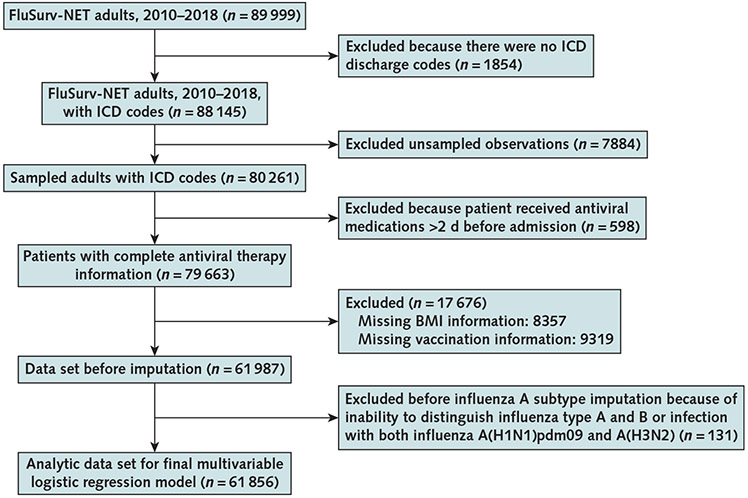
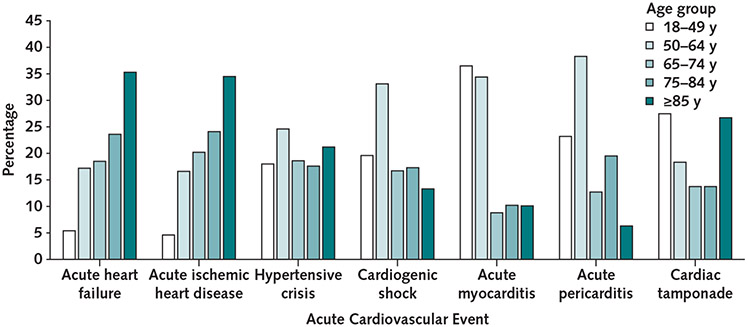
Among 89 999 adults with laboratory-confirmed influenza, 80 261 had complete medical record abstractions and available ICD codes (median age, 69 years interquartile range, 54 to 81 years) and 11.7% had an acute cardiovascular event. The most common such events (non-mutually exclusive) were aHF (6.2%) and aIHD (5.7%). Older age, tobacco use, underlying cardiovascular disease, diabetes, and renal disease were significantly associated with higher risk for aHF and aIHD in adults hospitalized with laboratory-confirmed influenza.
Limitation:
Underdetection of cases was likely because influenza testing was based on practitioner orders. Acute cardiovascular events were identified by ICD discharge codes and may be subject to misclassification bias.
Conclusion:
In this population-based study of adults hospitalized with influenza, almost 12% of patients had an acute cardiovascular event. Clinicians should ensure high rates of influenza vaccination, especially in those with underlying chronic conditions, to protect against acute cardiovascular events associated with influenza.
Primary Funding Source:
Centers for Disease Control and Prevention. -
Subjects:
-
Source:Ann Intern Med. 173(8):605-613
-
Pubmed ID:32833488
-
Pubmed Central ID:PMC8097760
-
Document Type:
-
Funding:
-
Volume:173
-
Issue:8
-
Download URL:
-
File Type:
 [PDF - 700.93 KB]
 -
Collection(s):
-
Main Document Checksum:urn:sha256:6b4385fddce4ba34c22f56640cf4a119546da484fc226f412186e81722febe9a
Supporting Files


File Language:
English
 Was this page helpful?
 Found an issue?

CDC STACKS serves as an archival repository of CDC-published products including
scientific findings, journal articles, guidelines, recommendations, or other public health information authored or
co-authored by CDC or funded partners.
As a repository, CDC STACKS retains documents in their original published format to ensure public access to scientific information.
As a repository, CDC STACKS retains documents in their original published format to ensure public access to scientific information.
You May Also Like
COLLECTION
CDC Public Access