



Association of genetic mutations and loss of ambulation in childhood-onset dystrophinopathy
Supporting Files

-
2 2021
-
Available in CDC Stacks on 2022-02-01T00:00:00Z
File Language:
English
Details
-
Alternative Title:Muscle Nerve
-
Personal Author:Haber, Gregory ; Conway, Kristin M. ; Paramsothy, Pangaja ; Roy, Anindya ; Rogers, Hobart ; Ling, Xiang ; Kozauer, Nicholas ; Street, Natalie ; Romitti, Paul A. ; Fox, Deborah J. ; Phan, Han C. ; Matthews, Dennis ; Ciafaloni, Emma ; Oleszek, Joyce ; James, Katherine A. ; Galindo, Maureen ; Whitehead, Nedra ; Johnson, Nicholas ; Butterfield, Russell J. ; Pandya, Shree ; Venkatesh, Swamy ; Bhattaram, Venkatesh Atul
-
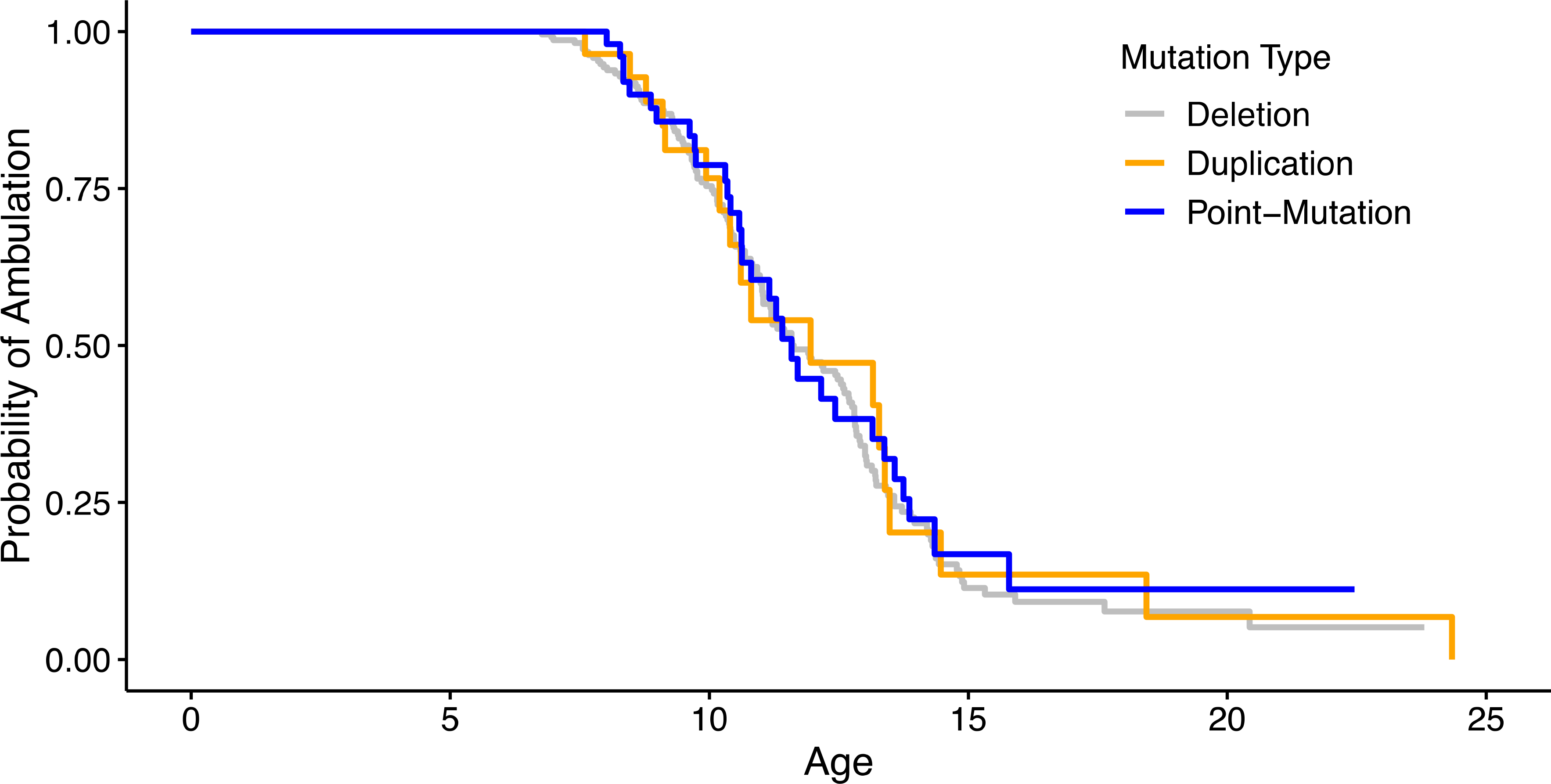
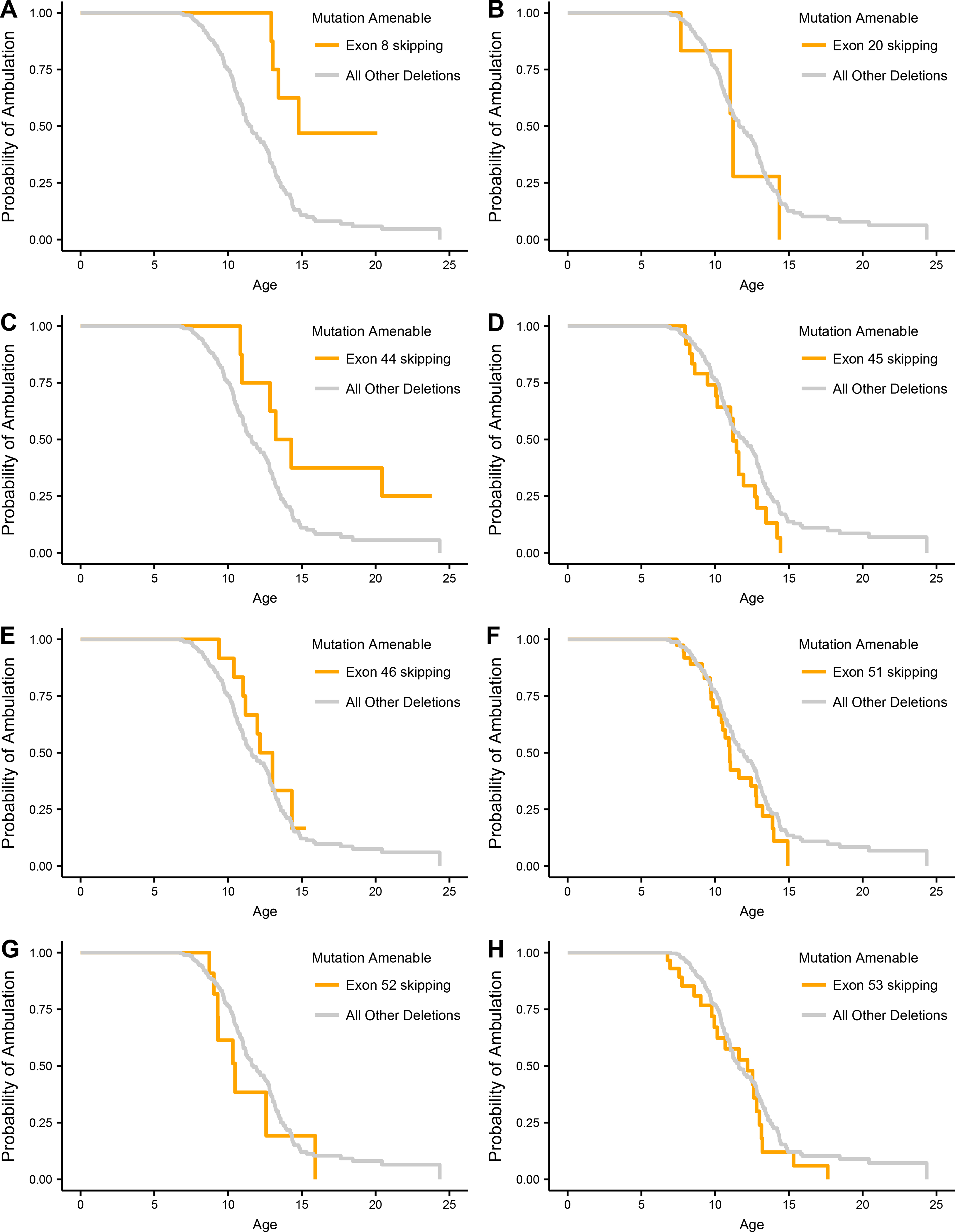
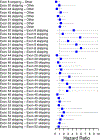
Description:Introduction ; Quantifying associations between genetic mutations and loss of ambulation (LoA) among males diagnosed with childhood-onset dystrophinopathy is important for understanding variation in disease progression and may be useful in clinical trial design. ; Methods ; Genetic and clinical data from the Muscular Dystrophy Surveillance, Tracking, and Research Network for 358 males born and diagnosed from 1982–2011 were analyzed. LoA was defined as the age at which independent ambulation ceased. Genetic mutations were defined by overall type (deletion/duplication/point mutation) and among deletions, those amenable to exon-skipping therapy (exons 8, 20, 44–46, 51–53) and another group. Cox proportional hazards regression modeling was used to estimate hazards ratios (HR) and 95% confidence intervals (CI). ; Results ; Mutation type did not predict time to LoA. Controlling for corticosteroids, Exons 8 (HR=0.22; 95% CI=0.08,0.63) and 44 (HR=0.30; 95% CI=0.12,0.78) were associated with delayed LOA compared to other exon deletions. ; Discussion ; Delayed LoA in males with mutations amenable to exon-skipping therapy is consistent with previous studies. These findings suggest that clinical trials including exon 8 and 44 skippable males should consider mutation information prior to randomization.
-
Subjects:
- Article
- Duchenne muscular dystrophy
- exon skipping
- loss of ambulation
- MD STARnet
- natural history study
- Adolescent
- Adrenal Cortex Hormones
- Child
- Dependent Ambulation
- Disease Progression
- Dystrophin
- Exons
- Gene Duplication
- Humans
- Male
- Mobility Limitation
- Muscular Dystrophy, Duchenne
- Point Mutation
- Proportional Hazards Models
- Sequence Deletion
- Wheelchairs
-
Source:Muscle Nerve. 63(2):181-191
-
Pubmed ID:33150975
-
Pubmed Central ID:PMC8094042
-
Document Type:
-
Funding:K08 NS097631/NS/NINDS NIH HHSUnited States/ ; U01 DD000187/DD/NCBDD CDC HHSUnited States/ ; U01 DD001247/DD/NCBDD CDC HHSUnited States/ ; U01DD001119/ACL/ACL HHSUnited States/ ; U01DD001108/ACL/ACL HHSUnited States/ ; CC999999/ImCDC/Intramural CDC HHSUnited States/ ; R01 FD006071/FD/FDA HHSUnited States/ ; U01 DD000191/DD/NCBDD CDC HHSUnited States/ ; U01 DD001248/DD/NCBDD CDC HHSUnited States/ ; U01DD001117/ACL/ACL HHSUnited States/ ; U01 DD001117/DD/NCBDD CDC HHSUnited States/ ; U01 DD000392/DD/NCBDD CDC HHSUnited States/ ; U01 DD001126/DD/NCBDD CDC HHSUnited States/ ; U01 DD001123/DD/NCBDD CDC HHSUnited States/ ; R01 NS104010/NS/NINDS NIH HHSUnited States/ ; U01DD001116/ACL/ACL HHSUnited States/ ; U01DD001123/ACL/ACL HHSUnited States/ ; U01 DD000189/DD/NCBDD CDC HHSUnited States/ ; U01 DD001116/DD/NCBDD CDC HHSUnited States/ ; U01DD001126/ACL/ACL HHSUnited States/ ; K23 NS091511/NS/NINDS NIH HHSUnited States/ ; U01 DD001119/DD/NCBDD CDC HHSUnited States/ ; U01 DD001108/DD/NCBDD CDC HHSUnited States/ ; U01 DD001255/DD/NCBDD CDC HHSUnited States/ ; U01 DD000190/DD/NCBDD CDC HHSUnited States/
-
Volume:63
-
Issue:2
-
Download URL:
-
File Type:
 [PDF - 994.69 KB]
 -
Collection(s):
-
Main Document Checksum:urn:sha256:69bed67d98722c3c9ea7486f04a34f7276f30b47d905a51a764b81974ace1e30
Supporting Files


File Language:
English
 Was this page helpful?
 Found an issue?




CDC STACKS serves as an archival repository of CDC-published products including
scientific findings, journal articles, guidelines, recommendations, or other public health information authored or
co-authored by CDC or funded partners.
As a repository, CDC STACKS retains documents in their original published format to ensure public access to scientific information.
As a repository, CDC STACKS retains documents in their original published format to ensure public access to scientific information.
You May Also Like
COLLECTION
CDC Public Access