


Assessment of Antibiotic Resistant Organism Transmission between Rooms of Hospitalized Patients, Healthcare Professionals, and the Hospital Environment Utilizing Surrogate Markers and Selective Bacterial Cultures
Supporting Files

-
5 2020
-
File Language:
English
Details
-
Alternative Title:Infect Control Hosp Epidemiol
-
Personal Author:
-
Corporate Authors:
-
Description:Objective:
To assess potential transmission of antibiotic resistant organisms (AROs) using surrogate markers and bacterial cultures.
Design:
pilot study.
Setting:
1,260-bed tertiary-care academic medical center.
Participants:
25 patients (17 on contact precautions for AROs) and 77 healthcare professionals (HCPs).
Methods:
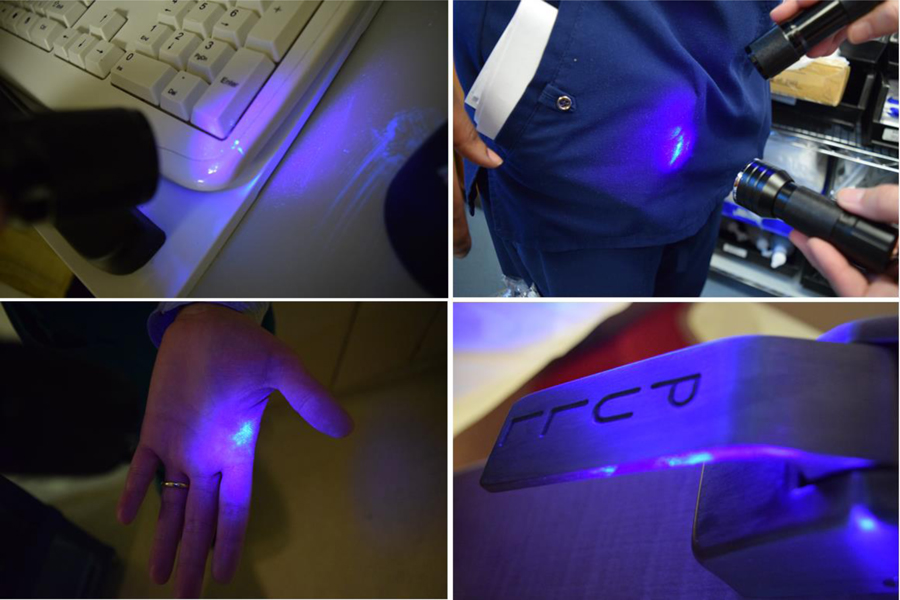
Fluorescent powder (FP) and MS2 bacteriophage were applied in patient rooms. HCP visits to each room were observed for 2–4 hours; hand hygiene (HH) compliance was recorded. Surfaces in and outside the room and HCP skin/clothing were assessed for fluorescence and swabs were collected for MS2 detection by PCR and selective bacterial cultures.
Results:
Transfer of FP was observed for 20 (80%) rooms and 26 (34%) HCPs. Transfer of MS2 was detected for 10 (40%) rooms and 15 (19%) HCPs. Bacterial cultures were positive for one room and 8 (10%) HCPs. Interactions with patients on contact precautions resulted in fewer FP detections than interactions with patients not on precautions (p<.001); MS2 detections did not differ by patient isolation status. FP detections did not differ by type of HCP, but MS2 was recovered more frequently from physicians vs. nurses (p=0.03). HH compliance was better among HCPs caring for patients on contact precautions vs. HCPs caring for patients not on precautions (p=0.003), among nurses vs. other non-physician HCPs at room entry (p=0.002), and among nurses vs. physicians at room exit (p=0.03). HCPs who performed HH prior to assessment had fewer fluorescence detections (p=0.008).
Conclusions:
Contact precautions were associated with greater HCP HH compliance and reduced detection of FP and MS2.
-
Subjects:
-
Source:Infect Control Hosp Epidemiol. 41(5):539-546
-
Pubmed ID:31969206
-
Pubmed Central ID:PMC7592156
-
Document Type:
-
Funding:K23 AI137321/AI/NIAID NIH HHSUnited States/ ; U54 CK000609/CK/NCEZID CDC HHSUnited States/ ; U54 CK000162/CK/NCEZID CDC HHSUnited States/ ; UL1 TR002345/TR/NCATS NIH HHSUnited States/ ; KL2 TR000450/TR/NCATS NIH HHSUnited States/ ; KL2 TR002346/TR/NCATS NIH HHSUnited States/ ; UL1 TR000448/TR/NCATS NIH HHSUnited States/
-
Volume:41
-
Issue:5
-
Collection(s):
-
Main Document Checksum:urn:sha256:d1ffe4e7b20bb2508dce7e88c204a80514fd39b1485e31e160f7ad46c818dfe3
-
Download URL:
-
File Type:
 [PDF
- 176.36 KB
]
[PDF
- 176.36 KB
]
Supporting Files


File Language:
English
ON THIS PAGE


CDC STACKS serves as an archival repository of CDC-published products including
scientific findings,
journal articles, guidelines, recommendations, or other public health information authored or
co-authored by CDC or funded partners.
As a repository, CDC STACKS retains documents in their original published format to ensure public access to scientific information.
As a repository, CDC STACKS retains documents in their original published format to ensure public access to scientific information.
You May Also Like
COLLECTION
CDC Public Access