


Post-Operative Biomarkers and Risk of Chronic Kidney Disease After Cardiac Surgery: the TRIBE-AKI Study
Supporting Files

-
July 25 2020
-
File Language:
English
Details
-
Alternative Title:Kidney Int
-
Personal Author:
-
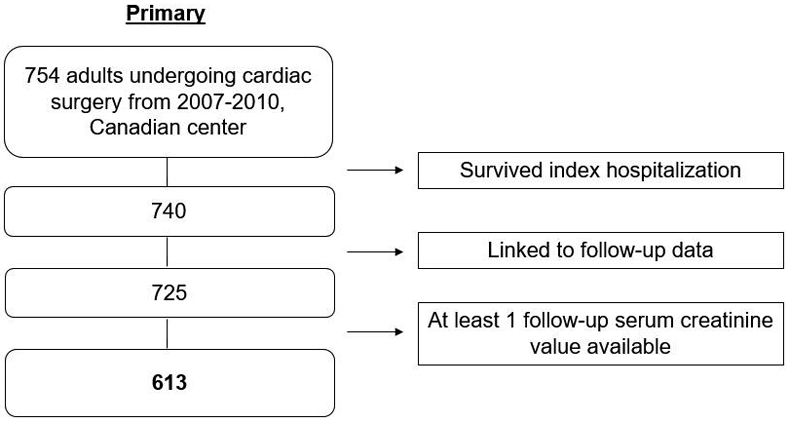
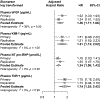
Description:Patients undergoing cardiac surgery are placed under intense physiologic stress. Blood and urine biomarkers measured peri-operatively may help identify patients at higher risk for adverse long-term kidney outcomes.We sought to determine independent associations of various biomarkers with development or progression of chronic kidney disease (CKD) following cardiac surgery. In this sub-study of the prospective cohort -TRIBE-AKI Study, we evaluated 613 adult patients undergoing cardiac surgery in Canada in our primary analysis and tested the association of 40 blood and urinary biomarkers with the primary composite outcome of CKD incidence or progression. In those with baseline estimated glomerular filtration rate (eGFR) over 60 mL/min/1.73m|, we defined CKD incidence as a 25% reduction in eGFR and an eGFR under 60. In those with baseline eGFR under 60 mL/min/1.73m|, we defined CKD progression as a 50% reduction in eGFR or eGFR under 15. Results were evaluated in a replication cohort of 310 patients from one study site in the United States. Over a median follow-up of 5.6 years, 172 patients developed the primary outcome. Each log increase in basic fibroblast growth factor (adjusted hazard ratio 1.52 [95% confidence interval 1.19, 1.93]), Kidney Injury Molecule-1 (1.51 [0.98, 2.32]), N-terminal pro-B-type natriuretic peptide (1.19 [1.01, 1.41]), and tumor necrosis factor receptor 1 (1.75 [1.18, 2.59]) were associated with outcome after adjustment for demographic factors, serum creatinine, and albuminuria. Similar results were noted in the replication cohort. Although there was no interaction by acute kidney injury in continuous analysis, mortality was higher in the no acute kidney injury group by biomarker tertile. Thus, elevated post-operative levels of blood biomarkers following cardiac surgery were independently associated with the development of CKD. These biomarkers can provide additional value in evaluating CKD incidence and progression after cardiac surgery.
-
Subjects:
-
Source:Kidney Int. 99(3):716-724
-
Pubmed ID:32721447
-
Pubmed Central ID:PMC8077034
-
Document Type:
-
Funding:R21 DK113420/DK/NIDDK NIH HHS/United States ; T32 HL007024/HL/NHLBI NIH HHS/United States ; K23 DK117065/DK/NIDDK NIH HHS/United States ; P30 DK079310/DK/NIDDK NIH HHS/United States ; U01 DK082185/DK/NIDDK NIH HHS/United States ; R01 DK112258/DK/NIDDK NIH HHS/United States ; R01 DK113191/DK/NIDDK NIH HHS/United States ; R01 HL085757/HL/NHLBI NIH HHS/United States ; R01 DK115562/DK/NIDDK NIH HHS/United States ; K24 DK090203/DK/NIDDK NIH HHS/United States ; U01 OH011326/OH/NIOSH CDC HHS/United States
-
Volume:99
-
Issue:3
-
Collection(s):
-
Main Document Checksum:urn:sha256:cc5c058b16f9e7a5961a3f45493805ba32089c137ba3ec10ef3b045991b9f2fc
-
Download URL:
-
File Type:
 [PDF
- 505.66 KB
]
[PDF
- 505.66 KB
]
Supporting Files


File Language:
English
ON THIS PAGE




CDC STACKS serves as an archival repository of CDC-published products including
scientific findings,
journal articles, guidelines, recommendations, or other public health information authored or
co-authored by CDC or funded partners.
As a repository, CDC STACKS retains documents in their original published format to ensure public access to scientific information.
As a repository, CDC STACKS retains documents in their original published format to ensure public access to scientific information.
You May Also Like
COLLECTION
CDC Public Access