



Evaluation of the National Electronic Injury Surveillance System – All injury program’s self-directed violence data, United States, 2018☆
Supporting Files

-
2 2021
-
Available in CDC Stacks on February 01, 2022, 12:00 AM
File Language:
English
Details
-
Alternative Title:J Safety Res
-
Personal Author:
-
Description:Introduction:
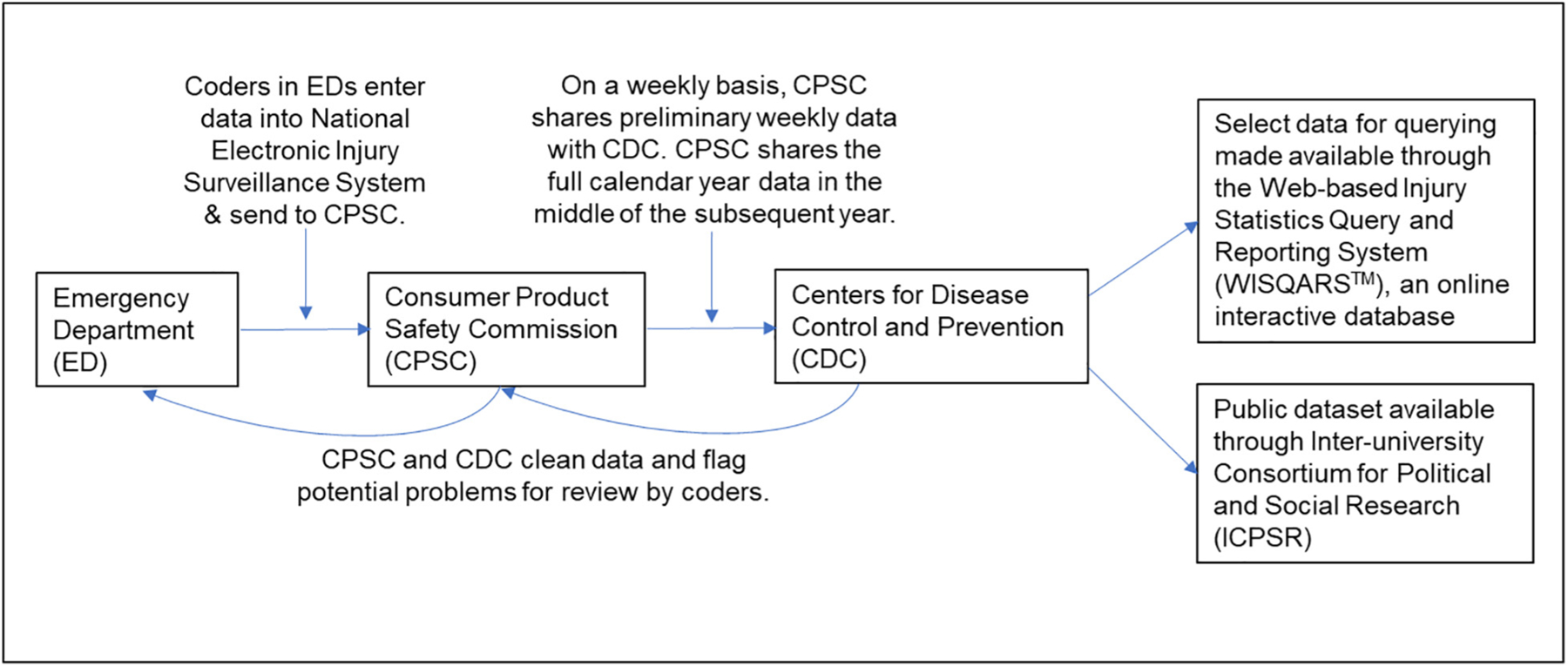
National estimates for nonfatal self-directed violence (SDV) presenting at EDs are calculated from the National Electronic Injury Surveillance System – All Injury Program (NEISS–AIP). In 2005, the Centers for Disease Control and Prevention and Consumer Product Safety Commission added several questions on patient characteristics and event circumstances for all intentional, nonfatal SDV captured in NEISS–AIP. In this study, we evaluated these additional questions along with the parent NEISS–AIP, which together is referred to as NEISS–AIP SDV for study purposes.
Methods:
We used a mixed methods design to evaluate the NEISS–AIP SDV as a surveillance system through an assessment of key system attributes. We reviewed data entry forms, the coding manual, and training materials to understand how the system functions. To identify strengths and weaknesses, we interviewed multiple key informants. Finally, we analyzed the NEISS–AIP SDV data from 2018—the most recent data year available—to assess data quality by examining the completeness of variables.
Results:
National estimates of SDV are calculated from NEISS–AIP SDV. Quality control activities suggest more than 99% of the cause and intent variables were coded consistently with the open text field that captures the medical chart narrative. Many SDV variables have open-ended response options, making them difficult to efficiently analyze.
Conclusions:
NEISS–AIP SDV provides the opportunity to describe systematically collected risk factors and characteristics associated with nonfatal SDV that are not regularly available through other data sources. With some modifications to data fields and yearly analysis of the additional SDV questions, NEISS–AIP SDV can be a valuable tool for informing suicide prevention.
Practical Applications:
NEISS-AIP may consider updating the SDV questions and responses and analyzing SDV data on a regular basis. Findings from analyses of the SDV data may lead to improvements in ED care. -
Subjects:
-
Source:J Safety Res. 76:327-331
-
Pubmed ID:33653565
-
Pubmed Central ID:PMC8040093
-
Document Type:
-
Funding:
-
Volume:76
-
Download URL:
-
File Type:
 [PDF - 475.28 KB]
 -
Collection(s):
-
Main Document Checksum:urn:sha-512:c0d8666e91a36f842862b3e2719f1b64c6fe4d0e717bf284e5ab556bbffc79dc1332b23502b92cb86b17faec43d9a15580794ac7dcb067bd853a10d7189bf584
Supporting Files


File Language:
English
 Was this page helpful?
 Found an issue?

CDC STACKS serves as an archival repository of CDC-published products including
scientific findings, journal articles, guidelines, recommendations, or other public health information authored or
co-authored by CDC or funded partners.
As a repository, CDC STACKS retains documents in their original published format to ensure public access to scientific information.
As a repository, CDC STACKS retains documents in their original published format to ensure public access to scientific information.
You May Also Like
COLLECTION
CDC Public Access