



Trends in Selected Chronic Conditions and Related Risk Factors Among Women of Reproductive Age: Behavioral Risk Factor Surveillance System, 2011–2017
Supporting Files

-
12-2020
-
Available in CDC Stacks on 2021-04-12T00:00:00Z
File Language:
English
Details
-
Alternative Title:J Womens Health (Larchmt)
-
Personal Author:
-
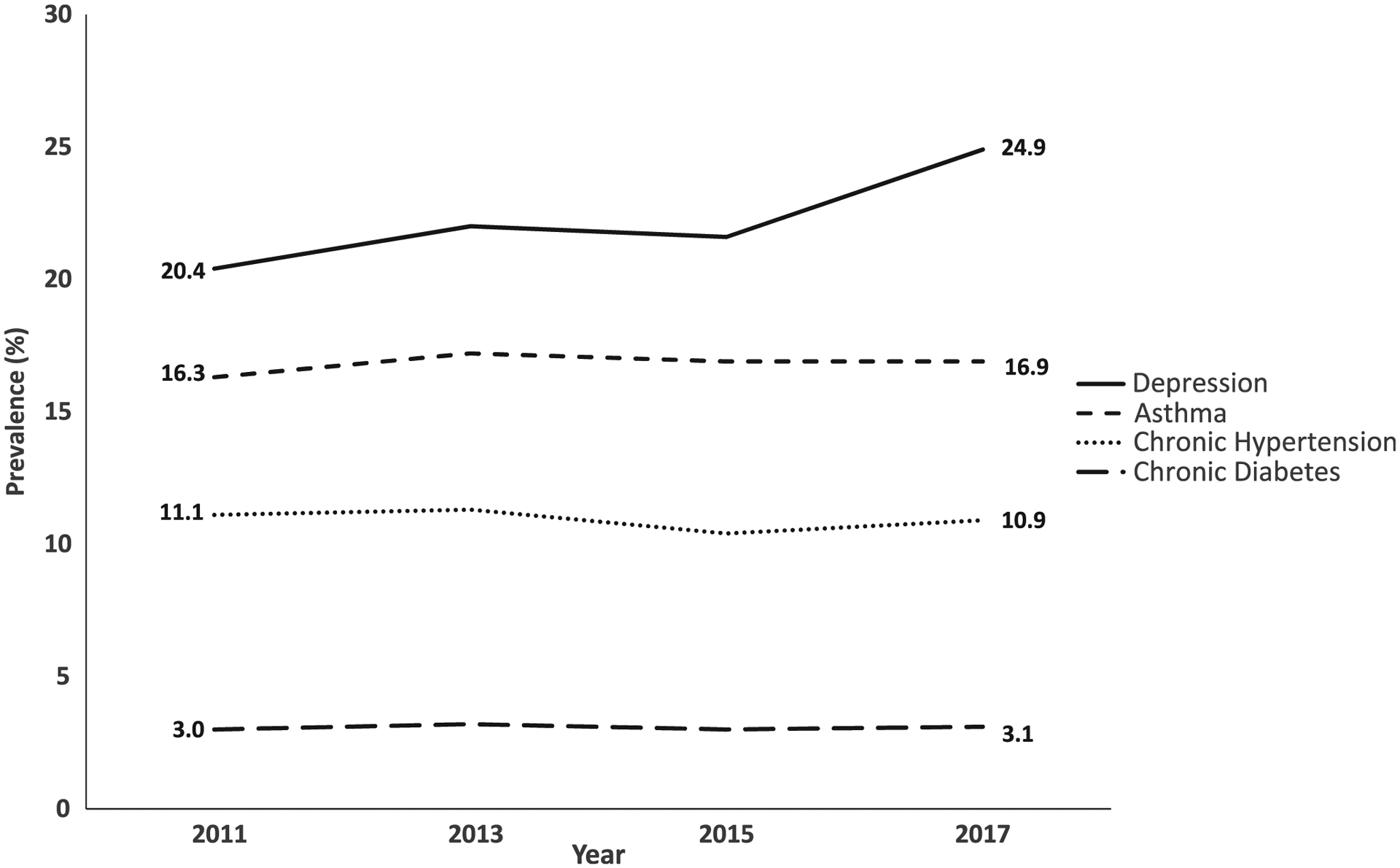
Description:Introduction: ; Chronic diseases in the United States are the leading drivers of disability, death, and health care costs. In women of reproductive age (WRA), chronic disease and related risk factors can also affect fertility and reproductive health outcomes. This analysis of trends from 2011 to 2017 adds additional indicators and updates an analysis covering 2001–2009. ; Methods: ; Data from the 2011–2017 Behavioral Risk Factor Surveillance System were analyzed for 265,544 WRA (18–44 years). To assess trends in 12 chronic conditions and related risk factors, we calculated annual prevalence estimates and adjusted prevalence ratios (APRs) with predicted marginals accounting for age, race, Hispanic ethnicity, education, and health care coverage. ; Results: ; From 2011 to 2017, prevalence decreased for current smoking (20.7%–15.9%; p < 0.001), gestational diabetes (3.1%–2.7%; p = 0.003), and high cholesterol (19.0%–16.7%; p < 0.001); prevalence increased for depression (20.4%–24.9%; p < 0.001) and obesity (24.6%–27.6%; p < 0.001). After adjustment, in 2017 WRA were more likely to report asthma (APR = 1.06; 95% confidence interval CI = 1.01–1.11), physical inactivity (APR = 1.08; 95% CI = 1.04–1.12), obesity (APR = 1.15; 95% CI = 1.11–1.19), and depression (APR = 1.29; 95% CI = 1.25–1.34) compared with 2011. They were less likely to report high cholesterol (APR = 0.89; 95% CI = 0.85–0.94) in 2015 compared with 2011, and current smoking (APR = 0.86; 95% CI = 0.82–0.89) and gestational diabetes (APR = 0.84; 95% CI = 0.75–0.94) in 2017 compared with 2011. ; Conclusions: ; Some chronic conditions and related risk factors improved, whereas others worsened over time. Research clarifying reasons for these trends may support the development of targeted interventions to promote improvements, potentially preventing adverse reproductive outcomes and promoting long-term health.
-
Subjects:
-
Keywords:
-
Source:J Womens Health (Larchmt). 29(12):1576-1585
-
Pubmed ID:32456604
-
Pubmed Central ID:PMC8039859
-
Document Type:
-
Funding:
-
Volume:29
-
Issue:12
-
Download URL:
-
File Type:
 [PDF - 247.63 KB]
 -
Collection(s):
-
Main Document Checksum:urn:sha-512:f7462fc47794eff74cf82e91f1b19315587e22061a2aa3dfdb489a18df463ed111c47df96437c0b193b3d6b10c9927098b19f0c12b99820142166a0cf6e982d5
Supporting Files


File Language:
English
 Was this page helpful?
 Found an issue?



CDC STACKS serves as an archival repository of CDC-published products including
scientific findings, journal articles, guidelines, recommendations, or other public health information authored or
co-authored by CDC or funded partners.
As a repository, CDC STACKS retains documents in their original published format to ensure public access to scientific information.
As a repository, CDC STACKS retains documents in their original published format to ensure public access to scientific information.
You May Also Like
COLLECTION
CDC Public Access