


High-Risk Opioid Prescribing Trends: Prescription Drug Monitoring Program Data from 2010–2018
Supporting Files

-
2021
-
File Language:
English
Details
-
Alternative Title:J Public Health Manag Pract
-
Personal Author:
-
Description:OBJECTIVE
Deaths due to opioids have continued to increase in South Carolina, with 816 opioid-involved overdose deaths reported in 2018, a 9% increase from the prior year. The objective of the current study is to examine longitudinal trends (Quarter (Q)1 2010 through Q4 2018) of opioid prescribing volume and high-risk opioid prescribing behaviors in South Carolina (SC) using comprehensive dispensing data available in the South Carolina Prescription Drug Monitoring Program (SC PDMP).
DESIGN
Retrospective analyses of SC PDMP data were performed using general linear models to assess quarterly time trends and change in rate of each outcome Q1 2010 through Q4 2018.
PARTICIPANTS
Opioid analgesic prescription fills from SC state residents between Q1 2010 through Q4 2018.
MAIN OUTCOME MEASURES
High-risk prescribing behaviors included: (1) opioid prescribing rate; (2) percent of patients receiving opioids dispensed ≥ 90 average morphine milligram equivalents daily; (3) percent of opioid prescribed days with overlapping opioid and benzodiazepine prescriptions; (4) rate per 100,000 residents of multiple provider episodes; and (5) percent of patients prescribed extended release opioids who were opioid-naive.
RESULTS
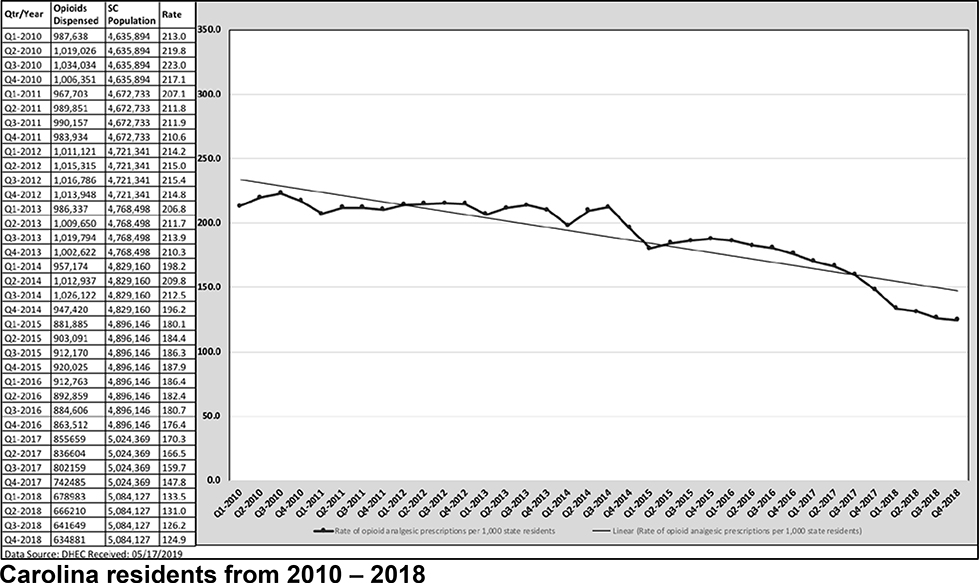
A total of 33,027,461 opioid prescriptions were filled by SC state residents within the time period of Q1 2010 through Q4 2018. A 41% decrease in the quarterly prescribing rate of opioids occurred from Q1 2010 to Q4 2018. The decrease in overall opioid prescribing was mirrored by significant decreases in all four high-risk prescribing behaviors.
CONCLUSION
PDMPs may represent the most complete data regarding the dispensing of opioid prescriptions and as such be valuable tools to inform and monitor the supply of licit opioids. Our results indicate that public health policy, legislative action, and multiple clinical interventions aimed at reducing high rates of opioid prescribing across the healthcare ecosystem appear to be succeeding in the state of SC.
-
Subjects:
-
Source:J Public Health Manag Pract. 27(4):379-384
-
Pubmed ID:32956292
-
Pubmed Central ID:PMC7940459
-
Document Type:
-
Funding:
-
Volume:27
-
Issue:4
-
Collection(s):
-
Main Document Checksum:urn:sha256:562ce37d61852d9dbaaca7b5f68c312be79f153675c4df94c2cee30c0241c7f2
-
Download URL:
-
File Type:
 [PDF
- 755.33 KB
]
[PDF
- 755.33 KB
]
Supporting Files


File Language:
English
ON THIS PAGE


CDC STACKS serves as an archival repository of CDC-published products including
scientific findings,
journal articles, guidelines, recommendations, or other public health information authored or
co-authored by CDC or funded partners.
As a repository, CDC STACKS retains documents in their original published format to ensure public access to scientific information.
As a repository, CDC STACKS retains documents in their original published format to ensure public access to scientific information.
You May Also Like
COLLECTION
CDC Public Access