



Putative Cut-Points in Sarcopenia Components and Incident Adverse Health Outcomes: An SDOC Analysis
Supporting Files

-
2020/07/01
-
Available in CDC Stacks on September 22, 2020, 12:00 AM
File Language:
English
Details
-
Alternative Title:J Am Geriatr Soc
-
Personal Author:Cawthon, Peggy M.
 ;
Manini, Todd
;
Patel, Sheena M.
;
Newman, Anne
;
Travison, Thomas
;
Kiel, Douglas P.
;
Santanasto, Adam J.
;
Ensrud, Kristine E.
;
Xue, Qian-Li
;
Shardell, Michelle
;
Duchowny, Kate
;
Erlandson, Kristine M.
;
Pencina, Karol M.
;
Fielding, Roger A.
;
Magaziner, Jay
;
Kwok, Timothy
;
Karlsson, Magnus
;
Ohlsson, Claes
;
Mellström, Dan
;
Hirani, Vasant
;
Ribom, Eva
;
Correa-de-Araujo, Rosaly
;
Bhasin, Shalender
;
Manini, Todd
;
Patel, Sheena M.
;
Newman, Anne
;
Travison, Thomas
;
Kiel, Douglas P.
;
Santanasto, Adam J.
;
Ensrud, Kristine E.
;
Xue, Qian-Li
;
Shardell, Michelle
;
Duchowny, Kate
;
Erlandson, Kristine M.
;
Pencina, Karol M.
;
Fielding, Roger A.
;
Magaziner, Jay
;
Kwok, Timothy
;
Karlsson, Magnus
;
Ohlsson, Claes
;
Mellström, Dan
;
Hirani, Vasant
;
Ribom, Eva
;
Correa-de-Araujo, Rosaly
;
Bhasin, Shalender
-
Description:OBJECTIVES:
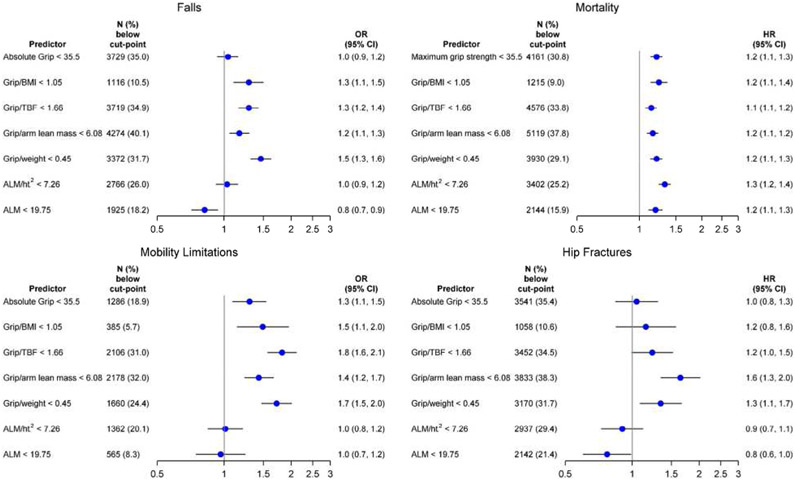
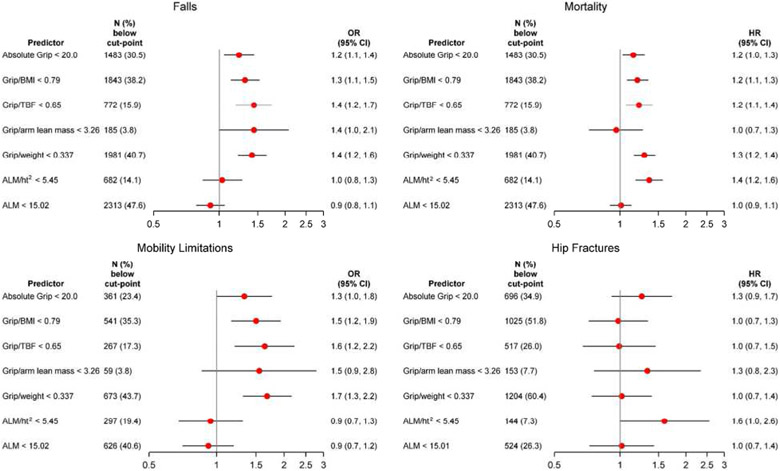
Analyses performed by the Sarcopenia Definitions and Outcomes Consortium (SDOC) identified cutpoints in several metrics of grip strength for consideration in a definition of sarcopenia. We describe the associations between the SDOC-identified metrics of low grip strength (absolute or standardized to body size/composition); low dual-energy x-ray absorptiometry (DXA) lean mass as previously defined in the literature (appendicular lean mass ALM/ht2); and slowness (walking speed <.8 m/s) with subsequent adverse outcomes (falls, hip fractures, mobility limitation, and mortality).
DESIGN:
Individual-level, sex-stratified pooled analysis. We calculated odds ratios (ORs) or hazard ratios (HRs) for incident falls, mobility limitation, hip fractures, and mortality. Follow-up time ranged from 1 year for falls to 8.8 ± 2.3 years for mortality.
SETTING:
Eight prospective observational cohort studies.
PARTICIPANTS:
A total of 13,421 community-dwelling men and 4,828 community-dwelling women.
MEASUREMENTS
Grip strength by hand dynamometry, gait speed, and lean mass by DXA.
RESULTS:
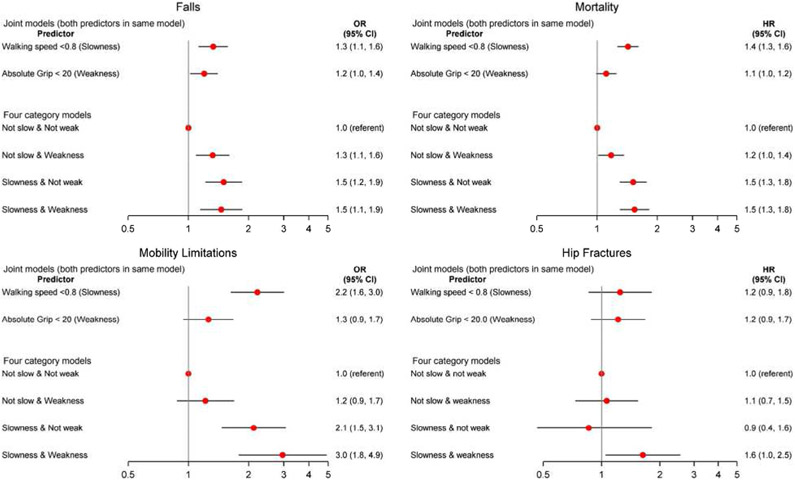
Low grip strength (absolute or standardized to body size/composition) was associated with incident outcomes, usually independently of slowness, in both men and women. ORs and HRs generally ranged from 1.2 to 3.0 for those below vs above the cut-point. DXA lean mass was not consistently associated with these outcomes. When considered together, those who had both muscle weakness by absolute grip strength (<35.5 kg in men and <20 kg in women) and slowness were consistently more likely to have a fall, hip fracture, mobility limitation, or die than those without either slowness or muscle weakness.
CONCLUSION:
Older men and women with both muscle weakness and slowness have a higher likelihood of adverse health outcomes. These results support the inclusion of grip strength and walking speed as components in a summary definition of sarcopenia. -
Keywords:
- sarcopenia
- grip strength
- gait speed
- hip fracture
- mobility limitation
- Absorptiometry, Photon
- Accidental Falls
- Aged
- Body Composition
- Body Mass Index
- Consensus
- Female
- Hand Strength
- Hip Fractures
- Humans
- Independent Living
- Male
- Mobility Limitation
- Muscle Strength
- Muscle Weakness
- Prospective Studies
- Sarcopenia
- Walking Speed
-
Source:J Am Geriatr Soc. 68(7):1429-1437
-
Pubmed ID:32633824
-
Pubmed Central ID:PMC7508260
-
Document Type:
-
Funding:S3486/CC/CDC HHSUnited States/ ; N01HC85081/HL/NHLBI NIH HHSUnited States/ ; N01HC85083/HL/NHLBI NIH HHSUnited States/ ; 5-P60-AR30701/AR/NIAMS NIH HHSUnited States/ ; K23 AG050260/AG/NIA NIH HHSUnited States/ ; N01AG62106/AG/NIA NIH HHSUnited States/ ; N01-HC-25195/HL/NHLBI NIH HHSUnited States/ ; N01AG62101/AG/NIA NIH HHSUnited States/ ; R01AG023629/AG/NIA NIH HHSUnited States/ ; R01 AG005407/AG/NIA NIH HHSUnited States/ ; U01 AG042139/AG/NIA NIH HHSUnited States/ ; U01HL130114/HL/NHLBI NIH HHSUnited States/ ; N01AG62103/AG/NIA NIH HHSUnited States/ ; U01 AG042140/AG/NIA NIH HHSUnited States/ ; UL1 TR000128/TR/NCATS NIH HHSUnited States/ ; U01 AG042168/AG/NIA NIH HHSUnited States/ ; U01HL080295/HL/NHLBI NIH HHSUnited States/ ; P30 AG024827/AG/NIA NIH HHSUnited States/ ; S043, S1734/CC/CDC HHSUnited States/ ; U01 AG042124/AG/NIA NIH HHSUnited States/ ; P30 AG031679/AG/NIA NIH HHSUnited States/ ; U01 HL130114/HL/NHLBI NIH HHSUnited States/ ; N01HC55222/HL/NHLBI NIH HHSUnited States/ ; U01 AG042145/AG/NIA NIH HHSUnited States/ ; P30 AG028747/AG/NIA NIH HHSUnited States/ ; N01HC85082/HL/NHLBI NIH HHSUnited States/ ; AG51421/AG/NIA NIH HHSUnited States/ ; R01 AG054366/AG/NIA NIH HHSUnited States/ ; U01 AG051421/AG/NIA NIH HHSUnited States/ ; R01 AR35582/NH/NIH HHSUnited States/ ; R01 AR 41398/NH/NIH HHSUnited States/ ; R01 AR049439-01A1/NH/NIH HHSUnited States/ ; P30 AG028740/AG/NIA NIH HHSUnited States/ ; R01 AG027576/AG/NIA NIH HHSUnited States/ ; R01 AG005394/AG/NIA NIH HHSUnited States/ ; HHSN268201200036C/HL/NHLBI NIH HHSUnited States/ ; R01 AG048069/AG/NIA NIH HHSUnited States/ ; HHSN268200800007C/HL/NHLBI NIH HHSUnited States/ ; U01 AR066160/AR/NIAMS NIH HHSUnited States/ ; R01AR35584/NH/NIH HHSUnited States/ ; R01 AR35583/NH/NIH HHSUnited States/ ; U01 AG027810/AG/NIA NIH HHSUnited States/ ; N01HC85080/HL/NHLBI NIH HHSUnited States/ ; K01 AG057726/AG/NIA NIH HHSUnited States/ ; R01 AG027574/AG/NIA NIH HHSUnited States/ ; U01 AG042143/AG/NIA NIH HHSUnited States/ ; R01AR057118/NH/NIH HHSUnited States/ ; HHSN268201800001C/HL/NHLBI NIH HHSUnited States/ ; U24AG051129/AG/NIA NIH HHSUnited States/ ; 5 P60 AR49465-03/AR/NIAMS NIH HHSUnited States/ ; N01HC85086/HL/NHLBI NIH HHSUnited States/ ; N01HC85079/HL/NHLBI NIH HHSUnited States/
-
Genre:
-
Volume:68
-
Issue:7
-
Download URL:
-
File Type:
 [PDF - 956.36 KB]
 -
Collection(s):
-
Main Document Checksum:urn:sha-512:fc2995f98784e3f9d8e808672f4809cb21b72968397986011d587368716ad6911641f0aaff9c494e9c88603bcdcb83ede54fe4de468fd33556c372e773bf54be
Supporting Files


File Language:
English
 Was this page helpful?
 Found an issue?



CDC STACKS serves as an archival repository of CDC-published products including
scientific findings, journal articles, guidelines, recommendations, or other public health information authored or
co-authored by CDC or funded partners.
As a repository, CDC STACKS retains documents in their original published format to ensure public access to scientific information.
As a repository, CDC STACKS retains documents in their original published format to ensure public access to scientific information.
You May Also Like
COLLECTION
CDC Public Access