



Trends and Geographic Patterns in Drug and Synthetic Opioid Overdose Deaths — United States, 2013–2019
Supporting Files
Public Domain

-
February 12 2021
File Language:
English
Details
-
Journal Article:Morbidity and Mortality Weekly Report (MMWR)
-
Personal Author:
-
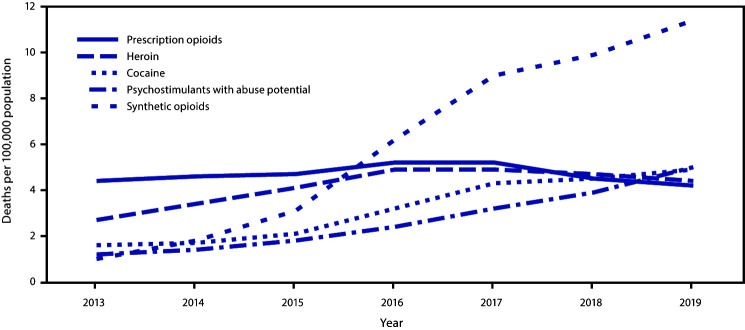
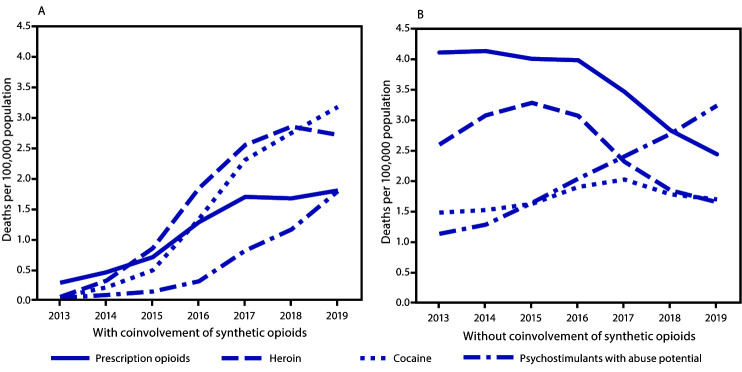
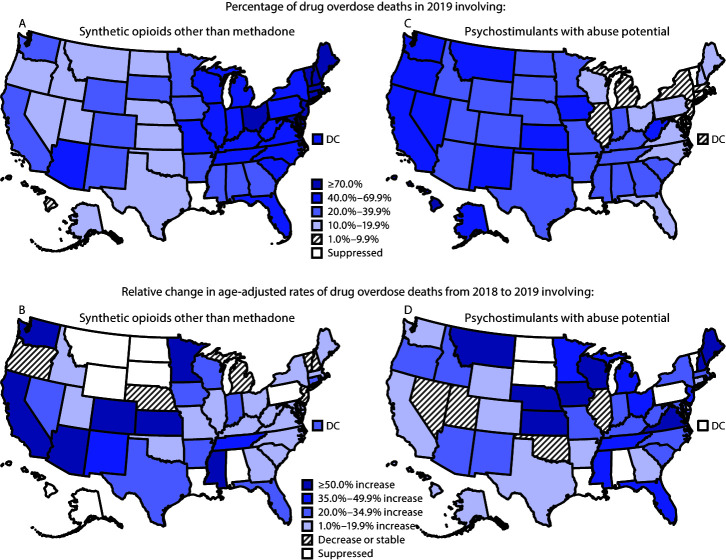
Description:Deaths involving synthetic opioids other than methadone (synthetic opioids), which largely consist of illicitly manufactured fentanyl; psychostimulants with abuse potential (e.g., methamphetamine); and cocaine have increased in recent years, particularly since 2013 (1,2). In 2019, a total of 70,630 drug overdose deaths occurred, corresponding to an age-adjusted rate of 21.6 per 100,000 population and a 4.3% increase from the 2018 rate (20.7) (3). CDC analyzed Trends in age-adjusted overdose death rates involving synthetic opioids, psychostimulants, cocaine, heroin, and prescription opioids during 2013-2019, as well as geographic patterns in synthetic opioid- and psychostimulant-involved deaths during 2018-2019. From 2013 to 2019, the synthetic opioid-involved death rate increased 1,040%, from 1.0 to 11.4 per 100,000 age-adjusted (3,105 to 36,359). The psychostimulant-involved death rate increased 317%, from 1.2 (3,627) in 2013 to 5.0 (16,167) in 2019. In the presence of synthetic opioid coinvolvement, death rates for prescription opioids, heroin, psychostimulants, and cocaine increased. In the absence of synthetic opioid coinvolvement, death rates increased only for psychostimulants and cocaine. From 2018 to 2019, the largest relative increase in the synthetic opioid-involved death rate occurred in the West (67.9%), and the largest relative increase in the psychostimulant-involved death rate occurred in the Northeast (43.8%); these increases represent important changes in the geographic distribution of drug overdose deaths. Evidence-based Prevention and response strategies including substance use disorder treatment and overdose Prevention and response efforts focused on polysubstance use must be adapted to address the evolving drug overdose epidemic.
-
Subjects:
-
Source:MMWR Morbidity Mortal Weekly Rep. 70(6):202-207
-
Series:
-
ISSN:0149-2195 (print) ; 1545-861X (digital)
-
Pubmed ID:33571180
-
Pubmed Central ID:PMC7877587
-
Document Type:
-
Place as Subject:
-
Pages in Document:6 pdf pages
-
Volume:70
-
Issue:6
-
Download URL:
-
File Type:
 [PDF - 3.29 MB]
 -
Collection(s):
-
Main Document Checksum:urn:sha-512:c9298f80f8dff1ee469a25cd0194cc7c1b0bd3aed9513da5fb5720c0556e374175775ddc0caa0f0bf35b934fa2b28b3dcd3e6b8afe7121196f047369614ee639
Supporting Files


File Language:
English
 Was this page helpful?
 Found an issue?

CDC STACKS serves as an archival repository of CDC-published products including
scientific findings, journal articles, guidelines, recommendations, or other public health information authored or
co-authored by CDC or funded partners.
As a repository, CDC STACKS retains documents in their original published format to ensure public access to scientific information.
As a repository, CDC STACKS retains documents in their original published format to ensure public access to scientific information.
You May Also Like
COLLECTION
Morbidity and Mortality Weekly Report (MMWR)