



Evaluation of Abbott BinaxNOW Rapid Antigen Test for SARS-CoV-2 Infection at Two Community-Based Testing Sites — Pima County, Arizona, November 3–17, 2020
Supporting Files
Public Domain

-
January 22 2021
File Language:
English
Details
-
Journal Article:Morbidity and Mortality Weekly Report (MMWR)
-
Personal Author:Prince-Guerra, Jessica L. ; Almendares, Olivia ; Nolen, Leisha D. ; Gunn, Jayleen K. L. ; Dale, Ariella P. ; Buono, Sean A. ; Deutsch-Feldman, Molly ; Suppiah, Suganthi ; Hao, LiJuan ; Zeng, Yan ; Stevens, Valerie A. ; Knipe, Kristen ; Pompey, Justine ; Atherstone, Christine ; Bui, David P. ; Powell, Tracy ; Tamin, Azaibi ; Harcourt, Jennifer L. ; Shewmaker, Patricia L. ; Medrzycki, Magdalena ; Wong, Phili ; Jain, Shilpi ; Tejada-Strop, Alexandra ; Rogers, Shannon ; Emery, Brian ; Wang, Houping ; Petway, Marla ; Bohannon, Caitlin ; Folster, Jennifer M. ; MacNeil, Adam ; Salerno, Reynolds ; Kuhnert-Tallman, Wendi ; Tate, Jacqueline E. ; Thornburg, Natalie J. ; Kirking, Hannah L. ; Sheiban, Khalilullah ; Kudrna, Julie ; Cullen, Theresa ; Komatsu, Kenneth K. ; Villanueva, Julie M. ; Rose, Dale A. ; Neatherlin, John C. ; Anderson, Mark ; Rota, Paul A. ; Honein, Margaret A. ; Bower, William A.
-
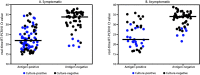
Description:Rapid antigen tests, such as the Abbott BinaxNOW COVID-19 Ag Card (BinaxNOW), offer results more rapidly (approximately 15-30 minutes) and at a lower cost than do highly sensitive nucleic acid amplification tests (NAATs) (1). Rapid antigen tests have received Food and Drug Administration (FDA) Emergency Use Authorization (EUA) for use in symptomatic persons (2), but data are lacking on test performance in asymptomatic persons to inform expanded screening tTesting to rapidly identify and isolate infected persons (3). To evaluate the performance of the BinaxNOW rapid antigen test, it was used along with real-time reverse transcription-polymerase chain reaction (RT-PCR) tTesting to analyze 3,419 paired specimens collected from persons aged ≥10 years at two community tTesting sites in Pima County, Arizona, during November 3-17, 2020. Viral culture was performed on 274 of 303 residual real-time RT-PCR specimens with positive results by either test (29 were not available for culture). Compared with real-time RT-PCR tTesting, the BinaxNOW antigen test had a sensitivity of 64.2% for specimens from symptomatic persons and 35.8% for specimens from asymptomatic persons, with near 100% specificity in specimens from both groups. Virus was cultured from 96 of 274 (35.0%) specimens, including 85 (57.8%) of 147 with concordant antigen and real-time RT-PCR positive results, 11 (8.9%) of 124 with false-negative antigen test results, and none of three with false-positive antigen test results. Among specimens positive for viral culture, sensitivity was 92.6% for symptomatic and 78.6% for asymptomatic individuals. When the pretest probability for receiving positive test results for SARS-CoV-2 is elevated (e.g., in symptomatic persons or in persons with a known COVID-19 exposure), a negative antigen test result should be confirmed by NAAT (1). Despite a lower sensitivity to detect infection, rapid antigen tests can be an important tool for screening because of their quick turnaround time, lower costs and resource needs, high specificity, and high positive predictive value (PPV) in settings of high pretest probability. The faster turnaround time of the antigen test can help limit Transmission by more rapidly identifying infectious persons for isolation, particularly when used as a component of serial tTesting strategies.
-
Subjects:
-
Source:MMWR Morbidity Mortal Weekly Rep. 70(3):100-105
-
Series:
-
ISSN:0149-2195 (print) ; 1545-861X (digital)
-
Pubmed ID:33476316
-
Pubmed Central ID:PMC7821766
-
Document Type:
-
Place as Subject:
-
Pages in Document:6 pdf pages
-
Volume:70
-
Issue:3
-
Download URL:
-
File Type:
 [PDF - 136.57 KB]
 -
Collection(s):
-
Main Document Checksum:urn:sha-512:95e3ae13d627d3ea6623ae0307a8995f12d1e84a508f7163e94b6ace6e0b0b0ee5e71918b9c36ab7448126a9d65192d7c19bf7230f5bed175d475a47cb5fe405
Supporting Files


File Language:
English
 Was this page helpful?
 Found an issue?


CDC STACKS serves as an archival repository of CDC-published products including
scientific findings, journal articles, guidelines, recommendations, or other public health information authored or
co-authored by CDC or funded partners.
As a repository, CDC STACKS retains documents in their original published format to ensure public access to scientific information.
As a repository, CDC STACKS retains documents in their original published format to ensure public access to scientific information.
You May Also Like
COLLECTION
Morbidity and Mortality Weekly Report (MMWR)